




Start here
Where are you in your journey?
Choose the path that fits today. We’ll take you to the most useful discussions.
- GLP-1 medication Zepbound, Wegovy, access, side effects, progress, and support.
- Before surgery Compare procedures, plan ahead, and get honest pre-op answers.
- Post-op Recovery, food stages, symptoms, and support.
- Long-term Regain, labs, habits, and life after the honeymoon.
- Revision Explore revision options, complications, and next steps.
Vertical Sleeve Gastrectomy Information by Dr. Gregg Jossart
- Replies 15
- Views 11.7k
- Created
- Last Reply
Top Posters In This Topic
-
JudyAnticola 2 posts
-
cajun 1 post
-
Tracy46545 1 post
-
Rgodinez 1 post




Most Popular Posts
-
sleeve gastrectomy hello Dr. I just had this operation done, i was obese but not brutally so, i basically carry 30kg (60pounds) of aditional weight, i ate too much and i coulnt control it. howev

Vertical Sleeve Gastrectomy Information by Dr. Gregg Jossart
Welcome to vertical sleeve talk. This forum is dedicated to providing patients with accurate and comprehensive information on the VSG procedure. This procedure is extremely appealing to many individuals considering weight loss surgery, but have been hesitant to proceed due to concerns about other, widely established procedures. If you have knowledge or questions about this topic, please participate by posting to our message board and introducing yourself.
History
The Vertical Sleeve Gastrectomy procedure (also called Vertical Gastrectomy, Sleeve Gastrectomy, Greater Curvature Gastrectomy, Parietal Gastrectomy, Gastric Reduction, Logitudinal Gastrectomy and even Vertical Gastroplasty) is performed by more than 50 surgeons worldwide. The procedure is titled VSG to include the two most common terms for the procedure(vertical and sleeve). The earliest forms of this procedure were conceived of by Dr. Jamieson in Australia(Long Vertical Gastroplasty, Obesity Surgery 1993)- and by Dr. Johnston in England in 1996 (Magenstrasse and Mill operation- Obesity Surgery 2003). In 1997, Dr. Gary Anthone refined the Duodenal Switch procedure to just the VSG in a patient with special indications. In 2001, Dr Gagner, in New York, offered the Laparoscopic VSG to a high risk patient who could not safely undergo a Duodenal Switch. In 2007, Dr Jossart and Dr. Cirangle in San Francisco published the largest series of over 200 patients with results comparable to other stapling procedures and superior to adjustable gastric banding. Their experience is now over 1300 patients. Several surgeons worldwide have now adopted the procedure and have offered it to low BMI and low risk patients as an alternative to laparoscopic banding of the stomach or as a safer option for higher risk, higher BMI patients.
Anatomy
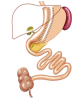
This procedure generates weight loss through gastric restriction (reduced stomach volume) and possibly by hormonal mechanisms. The stomach is restricted by stapling and dividing it vertically and removing more than 85% of it. This part of the procedure is not reversible. The stomach that remains is shaped like a very slim banana and measures from 1-5 ounces (30-150cc), depending on the surgeon performing the procedure. The nerves to the stomach and the outlet valve (pylorus) remain intact with the idea of preserving the functions of the stomach while reducing the volume.
Comparison to prior Gastroplasties(stomach stapling of the 70-80s)
The Vertical Gastrectomy is a significant improvement over prior gastroplasty procedures for a number of reasons:
1) Rather than creating a pouch with silastic rings or polypropylene mesh, the VSG actually resects or removes the majority of the stomach. The portion of the stomach which is removed is responsible for secreting Ghrelin, which is a hormone that is responsible for appetite and hunger. By removing this portion of the stomach rather than leaving it in-place, the level of Ghrelin is reduced to near zero, actually causing loss of or a reduction in appetite (Obesity Surgery, 15, 1024-1029, 2005). Currently, it is not known if Ghrelin levels increase again after one to two years. Patients do report that some hunger and cravings do slowly return. An excellent study by Dr. Himpens in Belgium(Obesity Surgery 2006) demonstrated that the cravings in a VSG patient 3 years after surgery are much less than in LapBand patients and this probably accounts for the superior weight loss.
2) The removed section of the stomach is actually the portion that stretches the most. The long vertical tube shaped stomach that remains is the portion least likely to expand over time and it creates significant resistance to volumes of food. Remember, resistance is greatest the smaller the diameter and the longer the channel. Not only is appetite reduced, but very small amounts of food generate early and lasting satiety(fullness).
3) Finally, by not having silastic rings or mesh wrapped around the stomach, the problems which are associated with these items are eliminated (infection, obstruction, erosion, and the need for synthetic materials). An additional discussion based on choice of procedures is below.
Alternative to a Roux en Y Gastric Bypass
The Vertical Gastrectomy is a reasonable alternative to a Roux en Y Gastric Bypass for a number of reasons:
1) Because there is no intestinal bypass, the risk of malabsorptive complications such as Vitamin deficiency and Protein deficiency is minimal.
2) There is no risk of marginal ulcer which occurs in over 2% of Roux en Y Gastric Bypass patients.
3) The pylorus is preserved so dumping syndrome does not occur or is minimal.
4) There is no intestinal obstruction since there is no intestinal bypass.
5) It is relatively easy to modify to an alternative procedure should weight loss be inadequate or weight regain occur.
6) The limited two year and 6 year weight loss data available to date is superior to current Banding and comparable to Gastric Bypass weight loss data(see Lee, Jossart, Cirangle Surgical Endoscopy 2007).
First stage of a Duodenal Switch
In 2001, Dr. Gagner performed the VSG laparoscopically in a group ofvery high BMI patients to try to reduce the overall risk of weight loss surgery. This was considered the first stage of the Duodenal Switch procedure. Once a patient's BMI goes above 60kg/m, it is increasingly difficult to safely perform a Roux-en-Y gastric bypass or a Duodenal Switch using the laparoscopic approach. Morbidly obese patients who undergo the laparoscopic approach do better overall in their recovery, while minimizing pain and wound complications, when compared to patients who undergo large, open incisions for surgery (Annals of Surgery, 234 (3): pp 279-291, 2001). In addition, the Roux-en-Y gastric bypass tends to yield inadequate weight loss for patients with a BMI greater than 55kg/m<(Annals of Surgery, 231(4): pp 524-528. The Duodenal Switch is very effective for high BMI patients but unfortunately it can also be quite risky and may be safer if done open in these patients. The solution was to stage the procedure for the high BMI patients.
The VSG is a reasonable solution to this problem. It can usually be done laparoscopically even in patients weighing over 500 pounds. The stomach restriction that occurs allows these patients to lose more than 100 pounds. This dramatic weight loss allows significant improvement in health and resolution of associated medical problems such as diabetes and sleep apnea, and therefore effectively downstages a patient to a lower risk group. Once the patients BMI is lower (35-40) they can return to the operating room for the second stage of the procedure, which can either be the Duodenal Switch, Roux en-Y gastric bypass or even a Lap-Band . Current, but limited, data for this two stage approach indicate adequate weight loss and fewer complications.
Vertical Gastrectomy as an only stage procedure for Low BMI patients(alternative to Lap-Band and Gastric Bypass).
The Vertical Gastrectomy has proven to be quite safe and quite effective for individuals with a BMI in lower ranges. The following points are based on review of existing reports:
Dr. Johnston in England, 10% of his patients did fail to achieve a BMI below 35 at 5 years and these tended to be the heavier individuals. The same ones we would expect to go through a second stage as noted above. The lower BMI patients had good weight loss (Obesity Surgery 2003).
In San Francisco, Dr Lee, Jossart and Cirangle initiated this procedure for high risk and high BMI patients in 2002. The results have been very impressive. In more than 1300 patients, there were no deaths, no conversions to open and a leak rate of less than .6%. The two year weight loss results are similar to the Roux en Y Gastric Bypass and the Duodenal Switch (81-86% Excess Weight Loss). Results comparing the first 216 patients are published in Surgical Endoscopy.. Earlier results were also presented at the American College of Surgeons National Meeting at a Plenary Session in October 2004 and can be found here:shakes, etc can be absorbed and may slow weight loss.
Frequently Asked Questions
How big will my stomach be after surgery?
The size of your stomach will vary depending on the surgeon. All surgeons use a tube to guide them when stapling the stomach. This tube size can vary from as small as 32 French Bougie(1-2 ounces) to as large as 64 French Bougie(6-8 ounces). This is a very important question to ask when considering this surgery, since those patients with larger pouches may have less weight loss.
How can I select a surgeon for this relatively new procedure?
The best results are usually going to correlate with surgeon experience. Any surgeon who has done more than 500 procedures for over 5 years in one location has probably optimized all elements of the operation and aftercare to obtain the best possible results. In addition, since the VSG stomach is the same as the Duodenal Switch stomach, any surgeon who has been doing duodenal switches laparoscopically is probably quite experienced with the VSG!
Is removing the stomach safe?
This type of stomach removal has been performed with the Duodenal Switch procedure since the mid 1980's. It does involve stapling, just like in the gastric bypass and has similar risks. Interestingly, patients do not ever return asking for their stomach back but many do wonder if it is possible to reduce the size of it again.
Will I need to take Vitamins?
Vitamin deficiencies are rare with this procedure because there is no intestinal bypass. However, the procedure is very restrictive so most surgeons recommend that patients take a Multivitamin, Calcium and possibly a B12 vitamin after surgery.
Will I regain weight?
All patients undergoing weight loss surgery are at risk for weight regain. None of the operations can prevent this. Those patients who maintain good dietary habits and exercise patterns are more likely to keep the weight off than those who do not exercise and who snack frequently.
What will my diet be like after surgery?
The diet will progress over the first year. It usually starts with 2-4 weeks of liquid Protein drinks and Water. Patients gradually progress to thicker food items and by two months are able to eat seafood, eggs, cheese and other regular foods. The diet generally recommended is low calorie(500 per day), high protein(70gm per day), low fat(30 gm per day) and low carbohydrates(40 gm per day). The calorie intake increases over the first year and by 12 months many patients have achieved their goal weight and consume between 900 and 1500 calories per day. This final calorie intake depends on level of activity, age and gender(men can usually consume more calories and maintain their weight).