Skip to content
View in the app

A better way to browse. Learn more.

BariatricPal

A full-screen app on your home screen with push notifications, badges and more.

To install this app on iOS and iPadOS
  1. Tap the Share icon in Safari
  2. Scroll the menu and tap Add to Home Screen.
  3. Tap Add in the top-right corner.
To install this app on Android
  1. Tap the 3-dot menu (⋮) in the top-right corner of the browser.
  2. Tap Add to Home screen or Install app.
  3. Confirm by tapping Install.

Join BariatricPal free

  • Ask your own questions
  • Reply and follow topics
  • Message other members
  • No cost, no spam

Rate of loss post-op

I was 335 in March. In anticipation of surgery I lost 55#, so at surgery (the day before yesterday) I was 280. My goal is 200 (okay, my secret goal is 190). What does the rate of loss look like? That is, do you lose steadily, or more quickly at first and then more slowly? How long should it take to lose the next 80#? My hope is to lose 50 in six months and the rest in the following six months. Is that realistic? As for exercise, I walk my dog about 1+ mile/day but hope to pick that up as I lose weight.

Edited by Jesse Liberty

  • Replies 27
  • Views 3.6k
  • Created
  • Last Reply

Top Posters In This Topic

Most Popular Posts

  • The Greater Fool
    The Greater Fool

    There are lies, damned lies, and statistics. You lose at your unique rate. Comparing to others, not matter how great yours are, are disappointing. Good luck, Tek

  • Everyone's mileage may vary, but I found this calculator turned out to be pretty accurate for me: https://mexicobariatriccenter.com/bariatric-surgery-weight-loss-timeline-calculator/ On the

  • sprukop0924
    sprukop0924

    Boy I hope this calculator is wrong! I'm just 3 mos out and down 50 lbs. According to this calculator, I can only expect to lose another 16 lbs?!!!!


Posted Images

Featured Replies

  • Popular Post

There are lies, damned lies, and statistics.

You lose at your unique rate. Comparing to others, not matter how great yours are, are disappointing.

Good luck,

Tek

Edited by The Greater Fool

it's a very individual thing, because it depends on so many factors, such as: gender, age, starting BMI, metabolic rate, whether or not you lost a lot of weight before surgery, activity level, how closely you stick to your clinic's program - etc etc etc

for your other question, yes, most people drop the most weight the first month or maybe two, then it slows down. The closer you get to goal, the slower it typically goes

Agree with others. Everyone is different and your body does not work linearly. I mean, I'm no where near goal and I have slowed to a crawl the past two to three months, without changing my eating (might be all the exercise, but hard to know, I'm just keeping on keeping on). Other people with my same stats could be dropping 2 or 3 times the weight I am - until their bodies decide not to and stop. It's not predictable and I find comparing myself to others does nothing helpful or useful.

The others are correct, weight loss, especially after WLS is never linear. If you were to graph it out, it would look more like exponential decay (with lots of fits and starts and even deviations up). At one point. I even tried graphing out my potential loss based on a decay constant but realized it was all based on my previous experience losing weight in the past. The decay constant will undoubtedly be different than my past attempts.

If it helps, I saw a couple of references in the scientific literature that suggest the AVERAGE across large population groups shows the weight lost at 2-4 months will be roughly 50% of that lost at 12 months.

As an example using totally made up numbers to make the math simple, let's say you lose 50 pounds in 3 months post-op. Then the average above would suggest you'd lose another 50 pounds in the next 9 months.

Again, these are averages. Your loss may be higher or lower than that depending on a lot of factors such as amount and type of exercise done, how compliant you are with your plan, total calories consumed, etc.

  • Author

So, one more question on this. Allowing for the fact that everyone is different, does losing more weight pre-op indicate faster or slower loss post-op?

9 minutes ago, Jesse Liberty said:

So, one more question on this. Allowing for the fact that everyone is different, does losing more weight pre-op indicate faster or slower loss post-op?

losing more weight pre-op generally means slower loss the first month. It's because a lot of the loss the first month is water weight. If you lost weight pre-op, then you've already lost the water weight. After that water weight drop, the rate of weight loss is about the same regardless if you lost weight pre-op or not.

  • Author
16 minutes ago, catwoman7 said:

losing more weight pre-op generally means slower loss the first month. It's because a lot of the loss the first month is Water weight. If you lost weight pre-op, then you've already lost the water weight. After that water weight drop, the rate of weight loss is about the same regardless if you lost weight pre-op or not.

Thank you... that makes sense. We are all so invested in this, and with very good reason. I want to wake up thin, and the "journey" to get there will take a while. ?

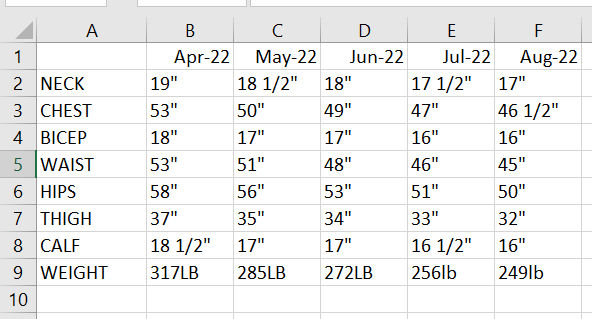
Here is my rate of loss. We are all different. We all hit stalls at different times.

Surgery Date was April 18th. and i take measurements and weight on the 4th of every month. So last measurement was August 4th.

aww.png

The matter that you have a guy metabolism, and have had a relatively easy pre op loss if a good indicator of fairly rapid progress post op, but no guarantees, of course.

I was also 335 at the start, lost about 50 fairly easily in the six month insurance diet/exercise effort (and then took a few years off before surgery - but kept the 50 off which led me toward the sleeve rather than something stronger like the DS, but I digress....) I was at 200 at six months post op, starting to ramp up the calories to slow things down toward my moving goal of 190ish (based upon body composition - fat mass, etc. - rather than BMI or scale weight.)

Wight loss is usually a stair step affair, in a decaying function (rapid at first and slowing over time). The matter that you have lost "fairly easily" to date is a good sign that your metabolism is still in decent shape - those who struggle at this point seem to be fighting a bigger metabolic problem and tend to be "slow losers" and will often struggle to get to their goal weight, if they get there at all. Slow weight loss pre op would encourage me to look at something metabolically stronger like the DS, which may be overkill for someone with a better metabolism.

In addition to general declining loss trends (mostly because it doesn't take as many calories to move around 200 lb as it does 300 lb, etc.) weight loss tends to be front loaded some by virtue that most of our initial loss has a large water weight component in it, and the body initially draws from its glycogen stores - basically stored carbs kept in the liver and muscle tissues, used for quick response energy needs. That needs the water to keep it in solution, and burns more rapidly than fat. Once we get through that - maybe 10-20 lb typically - we start drawing on fat stores, which goes slower. So, don't expect as big of a drop out of surgery as someone who hasn't lost anything pre op.

this is all so very interesting! i appreciate all the comments on this thread. I am one month post-op from bypass. I lost about 7 lbs my first week, and nothing since. However my clothes are fitting much better.

I had lost 40 lbs prior to surgery, plus 15 lbs on my pre-op diet. So these explanations really are making sense to me now.

Thank you!

20 hours ago, Elidh said:

Hi Jessica, Here’s a link to a bariatric surgery outcomes predictor that many professionals use:

https://michiganbsc.org/DecisionTools/

that this says that at 3 years I will have only lost 78 lbs, so I call BS

Everyone's mileage may vary, but I found this calculator turned out to be pretty accurate for me:

https://mexicobariatriccenter.com/bariatric-surgery-weight-loss-timeline-calculator/

On the morning of my surgery, I was 460.

This calculator put me at 372 at the 3 month mark. I was 381.

It had me at 325 at the six month mark. I was 331.

It had me at 267 at the year mark. I am at 261.

  • Author
3 hours ago, RickM said:

The matter that you have a guy metabolism, and have had a relatively easy pre op loss if a good indicator of fairly rapid progress post op, but no guarantees, of course...

Great analysis, thanks! Very helpful indeed.

21 hours ago, Elidh said:

Hi Jessica, Here’s a link to a bariatric surgery outcomes predictor that many professionals use:

https://michiganbsc.org/DecisionTools/

Boy I hope this calculator is wrong! I'm just 3 mos out and down 50 lbs. According to this calculator, I can only expect to lose another 16 lbs?!!!!
Join the conversation

You can post now and register later. If you have an account, sign in now to post with your account.

Guest
Reply to this topic...

Account

Navigation

Search

Search

Configure browser push notifications

Chrome (Android)
  1. Tap the lock icon next to the address bar.
  2. Tap Permissions → Notifications.
  3. Adjust your preference.
Chrome (Desktop)
  1. Click the padlock icon in the address bar.
  2. Select Site settings.
  3. Find Notifications and adjust your preference.