




Skip to content
View in the app

A better way to browse. Learn more.

BariatricPal

A full-screen app on your home screen with push notifications, badges and more.

To install this app on iOS and iPadOS
  1. Tap the Share icon in Safari
  2. Scroll the menu and tap Add to Home Screen.
  3. Tap Add in the top-right corner.
To install this app on Android
  1. Tap the 3-dot menu (⋮) in the top-right corner of the browser.
  2. Tap Add to Home screen or Install app.
  3. Confirm by tapping Install.

Join BariatricPal free

  • Ask your own questions
  • Reply and follow topics
  • Message other members
  • No cost, no spam

NHS Tier 4 - 2nd Appointment: The Saga Continues!

Cross-posted to General Weightloss Surgery Forum, but then thought it might be more appropriate here since I’m still pre-op. 🙃

It’s been a few months since I last posted, but having just had the 2nd consultation (out of 4 total) on my trust's Tier 4 pathway I thought I’d share that experience just in case anyone else is searching for information regarding the NHS process (even though it seems to vary rather greatly between trusts).

My 1st Tier 4 appointment was on 31 May with one of the bariatric dieticians (via phone call). My 2nd appointment was with the bariatric nurse on 2 September (also phone call). Like the previous appointment, I reported my weight and had a medication review. Then we went through “What To Expect for Pre-Op/Surgery/Post-Op/Hospital-Stay/Aftercare”. I was also greatly relieved to find out that my trust gives a 5kg “cushion” of possible weight gain before surgery - they seem very compassionate and understanding given the long waiting times post-Tier-3 discharge and the difficulty in either losing or maintaining one's weight. I AM SO RELIEVED I COULD CRY. 🙌

Originally, this trust had a 6-9 month wait time from Tier 3 discharge to Tier 4 surgery, but since a few surrounding trusts lost funding for their bariatric services, this trust has taken up the additional patients, so the wait time from Tier 3 discharge to surgery is more like 2-3 years now. 

We are hoping to have my last two appointments (in-person consultations with the anaesthetist and surgeon) before the end of the year. Once those appointments are done, the Tier 4 consultants will meet as part of the Multidisciplinary Team (MDT) review and decide whether or not I will be approved for surgery. And if approved, surgery is usually 1-2 months post-MDT meeting.

I won’t know who my surgeon is until I have the consultation - patients are assigned to whichever surgeon happens to be assigned to the bariatric clinic that day. Although I did find out that 4 out of the 5 surgeons in this department all perform robotic bariatric surgery via DaVinci, so that’s pretty cool. 

Also, it’ll be the Milk Diet for the Liver Reduction Diet. Good to know for the mental prep!

So far, my experience with the Tier 4 consultants and department secretary has been really, really good - I’ve always been met with kindness, encouragement, and compassion. Despite my own impatience, I’m so grateful for everyone I’ve encountered thus far and am looking forward to the next appointments!

Whelp. There we are. Hope this was helpful/insightful. We're getting there!  🫠

Any other pre-op NHSers here? If so, how’s your process going?

  • Replies 3
  • Views 686
  • Created
  • Last Reply

Top Posters In This Topic

Most Popular Posts

  • Thanks for your story. It was very interesting to read. If you don’t mind me asking what it is the Tier system you’re referring to? I’m in the states so it went over my head. I’m going through Veteran

  • Bari_Hopeful
    Bari_Hopeful

    Good question! As an American-settled-in-the-UK this continues to be a learning opportunity for me. 😅 So, in the UK we have the National Health Service (NHS) which provides general health care for

  • Thank you for the detailed explanation. It’s interesting how different the US healthcare system is. I was just curious.
Posted Images

Featured Replies

Thanks for your story. It was very interesting to read. If you don’t mind me asking what it is the Tier system you’re referring to? I’m in the states so it went over my head. I’m going through Veteran Affairs Health System and not insurance.

I’m glad your expectations have been meet and will continue to be.

  • Author
8 hours ago, Gojos Girl said:

Thanks for your story. It was very interesting to read. If you don’t mind me asking what it is the Tier system you’re referring to? I’m in the states so it went over my head. I’m going through Veteran Affairs Health System and not insurance.

I’m glad your expectations have been meet and will continue to be.

Good question! As an American-settled-in-the-UK this continues to be a learning opportunity for me. 😅

So, in the UK we have the National Health Service (NHS) which provides general health care for everyone; however, if you can afford it, you may also purchase private health insurance and go to private hospitals/doctors to receive treatment much faster. Now, (as I understand it, though I am more than happy to be corrected on this) all the public hospitals and healthcare facilities throughout the UK are grouped together geographically under “trusts” (kind of like state or county boundaries) and each trust determines how their finances (allotted by the government) are distributed to cover which departments of healthcare.

Aaand now to the Tiers!

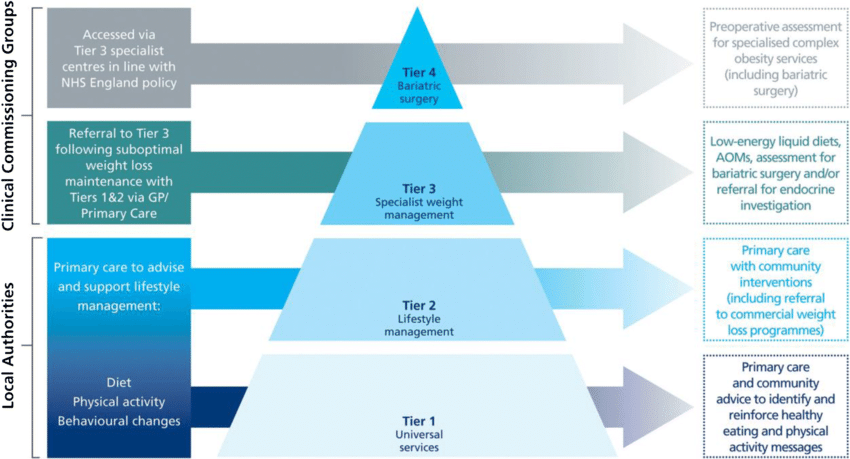
Perhaps as a way to weed people out, the weight management services offered via the NHS have progressive levels of treatment. (See photo below to see how it progresses upward in a narrowing manner.)

IMG_4864.png

Tiers 1-2 involve your local doctor and local service to help manage weight, like joining Weight Watchers or Slimming World and checking in regularly with your doctor. Tier 3 requires a referral from your primary care doctor to a Tier 3 provider (my trust used “The Weigh Ahead” which was operated through a private hospital group (Spire). (It took about 9 months from referral to 1st Tier 3 appointment.) My Tier 3 program lasted 6 months and could be extended 6 additional months if desired (I agreed to that because the support was so helpful). It comprised of monthly virtual meetings with a someone to go over nutrition and exercise goals, keep track of weight, measurements, and blood pressure, and general accountability and encouragement. I also had about 3 or 4 meetings with an NHS bariatric psychologist to go through any issues that might come up regarding food, surgery, eating disorders, etc. Both cleared me for moving forward towards surgery and thus, Tier 4. Also, by the end of Tier 3, you are expected to have lost 5-10% of your body weight before being discharged and referred to Tier 4.

From Tier 3 discharge to my first Tier 4 appointment it was approximately 18 months.

(Also, for some trusts, their Tier 3 programs can now offer GLP-1s. Mine was not one of them, alas!)

Tier 4 is nearing the homestretch! Here you meet with various consultants (dietitian, bariatric nurse, anaesthesiologist, surgeon - and some Tier 4s may require a psychological evaluation, if it wasn’t covered in Tier 3) to see if you’re mentally and physically fit and ready for surgery. (I’ve heard some Tier 4 programs may also offer the alternative option of GLP-1s.) I’m not sure if Tier 4 also includes aftercare, but if it does, then that’s 2 years of follow-up and support offered from the Tier 4 bariatric team, which includes access to the dietitian and bariatric psychologist. After 2 years, you return to your primary care doctor for follow-up and monitoring.

If you've made it this far, thank you for time and curiosity. 🤓

Join the conversation

You can post now and register later. If you have an account, sign in now to post with your account.

Guest
Reply to this topic...

Account

Navigation

Search

Search

Configure browser push notifications

Chrome (Android)
  1. Tap the lock icon next to the address bar.
  2. Tap Permissions → Notifications.
  3. Adjust your preference.
Chrome (Desktop)
  1. Click the padlock icon in the address bar.
  2. Select Site settings.
  3. Find Notifications and adjust your preference.