




The study that convinced me to have surgery
- Replies 6
- Views 4.4k
- Created
- Last Reply
Top Posters In This Topic
-
GreenTealael 1 post
-
Lynnlovesthebeach 1 post
-
ms.sss 1 post
-
star618 1 post




Popular Days
Most Popular Posts
-
At my last followup visit with my surgeon I had lost 103% of my excess body weight. He was so impressed. I have lost 53% of my highest recorded weight from 5 yrs ago. I did the diet roller coaster for
-
Very helpful & I'm a ? for cited sources
-
Same!
Posted Images
Featured Replies
Join the conversation
You can post as a guest; create a free account to track replies, follow topics, and be part of the largest weight loss surgery community.
"Bariatric Surgery is probably one of the most effective interventions in health care."
- Laurie K. Twells, clinical epidemiologist at Memorial University of Newfoundland [2]
Are you lurking on these forums debating whether or not you should have surgery? Unsure about making a permanent change to your lifestyle and body, or thinking that since you lost x number of lbs before, you can do it again? Heard about all the horror stories of complications and regain? This was me, one year ago. I want to tell you about the study that changed my mind.
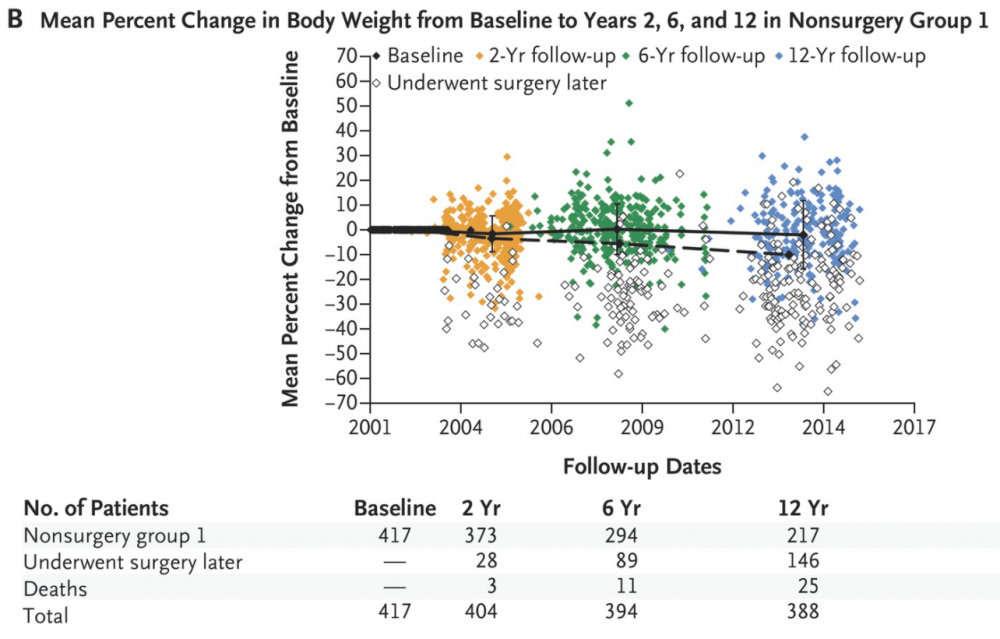
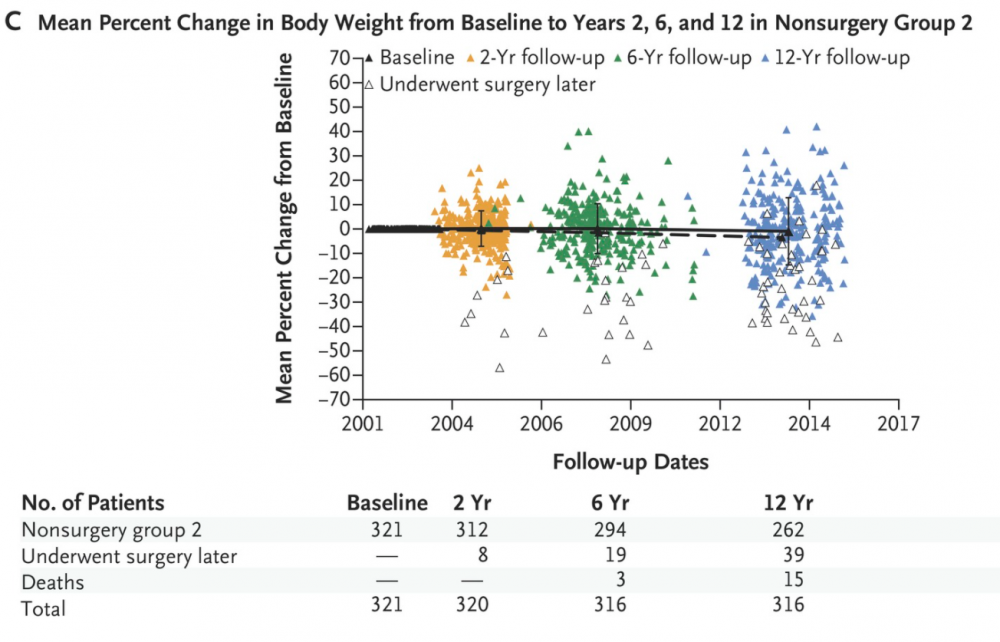
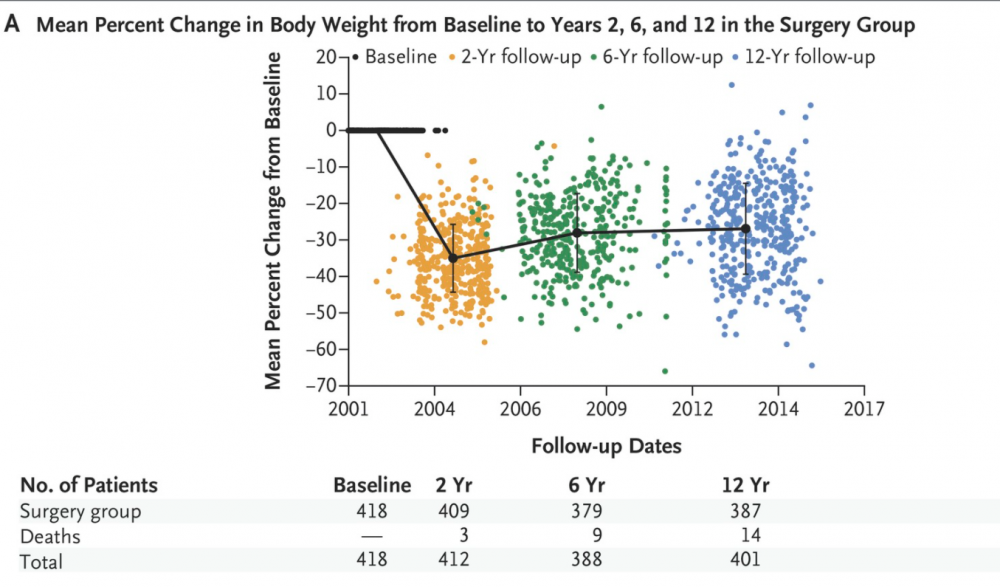
This study[1] looked at three groups: 418 patients who sought and underwent Roux-en-Y gastric bypass (surgery group), 417 patients who sought but did not undergo surgery (primarily for insurance reasons) (nonsurgery group 1), and 321 patients who did not seek surgery (nonsurgery group 2). They performed clinical examinations at baseline and at 2 years, 6 years, and 12 years to ascertain the presence of type 2 diabetes, hypertension, and dyslipidemia.
Let me highlight a couple images from their study. These charts graph the amount patients lost as a percentage of total weight (NOT excess weight) at 2, 6, and 12 years relative to their baseline. First, this graph is the individuals who did not seek surgery.
This group lost only 0.9% of their total weight 12 years after the study began. Those empty triangles? Those are people who ended up getting bariatric surgery anyways. Lets look at the second group, people tho sought out surgery but couldn't get it. So at least we are aware that this group is invested in losing weight.
This group fared slightly better, as patients lost a mean of 2% of their body weight at 12 years out. This excludes patients who got surgery (they lost an average of 10%). Lets look at patients who did get the surgery.
Patients lost an average of 26% of their total body weight even after 12 years. I found this difference absolutely remarkable. To reach that average 26% body weight loss without surgery, you would need to be in the top 5-10% of losers. Think about that.
I used to see getting the surgery as an admission of my own personal failure at willpower and dieting. But this study makes it clear that the probability of success for non-surgical options is astoundingly low relative to bariatric surgery. Studies [3], [4], [5] reinforce the positive impact on health that bariatric surgery has on patients who choose to go through with it. Reading these helped put my mind at ease. Bariatric surgery is one of the best decisions I could make for my health.
I encourage you to skim through the studies to see other benefits I didn't outline here. The NYT[2] article is also a great read for seeing why bariatric surgery is so effective. It distills a lot of the studies into facts that you can use to arm yourself when speaking with family and friends who aren't supportive.
Sources:
[1] https://www.nejm.org/doi/full/10.1056/NEJMoa1700459
[2] https://www.nytimes.com/2017/02/13/well/why-weight-loss-surgery-works-when-diets-dont.html
[3] https://link.springer.com/article/10.1007%2Fs11695-012-0718-9
[4] https://onlinelibrary.wiley.com/doi/full/10.1002/oby.21322
[5] https://jamanetwork.com/journals/jamasurgery/fullarticle/2546331#Introduction
Edited by Double_Me