Skip to content
View in the app

A better way to browse. Learn more.

BariatricPal

A full-screen app on your home screen with push notifications, badges and more.

To install this app on iOS and iPadOS
  1. Tap the Share icon in Safari
  2. Scroll the menu and tap Add to Home Screen.
  3. Tap Add in the top-right corner.
To install this app on Android
  1. Tap the 3-dot menu (⋮) in the top-right corner of the browser.
  2. Tap Add to Home screen or Install app.
  3. Confirm by tapping Install.
  • Appearance

Join BariatricPal free

  • Ask your own questions
  • Reply and follow topics
  • Message other members
  • No cost, no spam

Proteinaholic by Dr Garth Davis

  • Popular Post

I know this was mentioned before here in the Vegans/Vegetarians forums and I wanted to maybe start this thread for all things pertaining to the book that Dr. Garth Davis authored, Proteinaholic. So far I'm on chapter 6 of it and I'm just amazed with how sound it is and all the studies that are out there to support why we don't need such a high amount of protein, and why it's a culprit of obesity, high blood pressure, diabetes, etc.... There's just so much to talk about if anyone wants to get into discussion. Now, this thread IS NOT going to be for debate. I do not want anyone coming on here advocating high protein and what they "know" and debating with any of us who are or evolving into plant based, vegans or vegetarians. I want to share the things I've learned from the book and if anyone wants to challenge those, READ THE BOOK FIRST, and then you can come and talk about it. If you don't or haven't read the book, feel free to read the things that will be posted...and do your own homework to find these facts/truths out for yourself. I literally don't have time to do a protein ping pong match...so don't start one. You will be ignored.

Okay, with that said and out of the way, the first thing I want to mention is that Dr. Davis actually dispels the myths about protein and why our bodies don't need so much. It is not an opinionated book, it's a science/fact book. It makes TOTAL sense. He is quite comical too. The parts where he plays out his doctor/patient dialogues hit me the most...because I can relate to how I was educated about protein being what we all need. I had the same mentalities as he did regarding it, but after I started watching documentaries on plant based diets for the past couple of years, I've slowly become open to all the health benefits of eating plant based. But now, even though I knew plant based is great for the health, I didn't know that the protein component was/is what was causing so many problems in my health, my husband's, etc. Now, I've got science and truth to understand the premise of protein. The history of why, what Dr Davis talks about, we western society pick apart whole foods and live based off of macronutrients. Now, it just boggles me why we do that. The other thing that rings true and is nice knowing, is that he is a bariatric surgeon too. He knows what he's coaching/telling his patients. He knows that he was not a nutritionist, didn't know a single thing, but the one hour of nutrition studies in his school days, but he took the time to dive into history, studies, reports, etc to bring light to why western society is so unhealthy, and most of it is based on animal protein.

Wow.

Read the book!

  • Replies 495
  • Views 48.5k
  • Created
  • Last Reply

Top Posters In This Topic

Most Popular Posts

  • swimbikerun
    swimbikerun

    What I find very interesting is you ask people why they have 60 grams of protein for sleeve patients, and why it is the same in the first couple months after surgery as for the rest of their lives and

  • Thus Proteinaholics! He talks about Cognitive Dissonance. "This occurs when someone has such a strong prior belief that the person filters out or reinterprets all evidence contradicting the beli

  • Dinner at my house tonight.

Posted Images
Featured Replies

  • Author
1 hour ago, Apple1 said:

Really everyone just needs to research for themselves

Totally agree with this. We can only share our experiences and results with others, but ultimately each need to figure it out for her/his self. I like to live against the grain...just because the world does it like this, or the lame media shows something, doesn't mean I have to or should and it doesn't mean it's true. Fact check on your own. Goes with political agendas too. <---of which I will TOTALLY not elaborate on here. Just making a point that too many people aren't thinking for themselves.

@Berry78 I am happy for your research too and everyone else here. Great job....especially you APPLE!!! LOL I've got a soft spot for you. :)

On 27.9.2017 at 6:54 PM, FluffyChix said:

The people I've seen have been members of a WLS board, who announce that they are back on their metformin or insulin or diabetes drugs. I've no proof, but would suspect that they are "cheating" and eating C.R.A.P., but that's pretty uncharitable of me.

Maybe this low carb approach really doesn't work in the long run? ;) Of course it's always easier to blame the patient instead of the diet.

5 hours ago, Newme17 said:

Great job....especially you APPLE!!! LOL I've got a soft spot for you. :)

AW thank you @Newme17. We are sleeve sisters :) and I feel the same.

I wanted to share this information on the thread. I thought it was great.

The Five Pillars of Healthy Eating
"A Common Sense Approach To Nutrition"


1) Plant-Centered - Center your plate and your diet predominately around plant foods (fruits, vegetables, starchy vegetables, roots/tubers, intact whole grains, and legumes (beans, peas & lentils).

2) Minimally Processed - Enjoy foods as close to "as grown in nature" with minimal processing that does not detract from the nutritional value &/or add in any harmful components.

3) Calorie Dilute - Follow the principles of calorie density choosing foods that are calorie adequate, satiating and nutrient sufficient.

4) Low S-O-S - Avoid/minimize the use of added Salts/sodium, Oils/Fats and Sugars/sweeteners

5) Variety - Consume a variety of foods in each of the recommended food groups.

The Principles of Calorie Density

1) Hunger & Satiety - Whenever hungry, eat until you are comfortably full. Don't starve and don't stuff yourself.

2) Sequence Your Meals - Start all meals with a salad, soup and/or fruit. By starting with the foods that are lowest in calorie density, you begin to fill up for fewer calories.

3) Don't Drink Your Calories - Avoid liquid calories. Eat/chew your calories, don't drink or liquefy them. Liquids have little if any satiety so they do not fill you up as much as solid foods of equal calories.

4) Dilution is the Solution (the 50/50 guideline) - Dilute Out High Calorie Dense Foods/Meals - Dilute the calorie density of your meals by filling 1/2 your plate (by visual volume) with intact whole grains, starchy vegetables and/or legumes and the other half with non-starchy vegetables and/or fruit.

5) Be Aware of the Impact of Vegetables vs Fat/Oil - Non-starchy vegetables are the lowest in calorie density while fat and oil are the highest. Therefore, adding non-starchy vegetables to any dish will always lower the overall calorie density of a meal while adding fat and oil will always raise the overall calorie density of a meal.

6) Limit High Calorie Dense Foods - Limit (or avoid) foods that are higher in calorie density. These include dried fruit, high fat plant foods (nuts, seeds, avocados), processed whole grains (breads, bagels, crackers, dry cereal, tortilla's, popcorn, etc). If you use them, incorporate them into meals that are made up of low calorie dense foods and think of them as a condiment to the meal. For example, add a few slices of avocado added to a large salad, or a few walnuts or raisins added in a bowl of oatmeal and fruit.

In addition, include about 30-60 minutes of activity a day (including some aerobic, resistance and flexibility exercise), aim for a BMI of around 18.5-22 and get enough sleep, rest, relaxation, recreation, fresh air, pure water, etc and enjoy life!

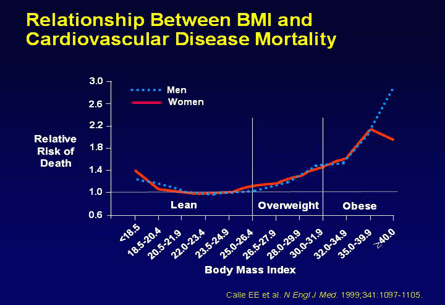
Very nice. And I agree with almost all of it... but the healthiest BMIs are actually more like 22-26.5 for men and 20.5 to 25 for women.

73d6cb0582a9109168189e33842258b6.jpg

2 hours ago, Berry78 said:

Very nice. And I agree with almost all of it... but the healthiest BMIs are actually more like 22-26.5 for men and 20.5 to 25 for women.

73d6cb0582a9109168189e33842258b6.jpg

When I look at that graph I see a difference of about .2 between the category BMI 18.5-20.4 and the 22.0-23.4 for men. It starts to go up at about 25. Considering the BMI Dr. McDougall recommends spans both of those categories I would say it is close enough to be almost the same. When I look at women I see a relatively flat line from 18.5 all the way to 25 so again I can't see a difference worth noting.

Are you seeing something I'm not?

Thanks for pointing that out.. you're right, the line I was looking at was 18.5 for women. Oops. ;) Guess I just was looking at the 20.4. I did the same mistake for the men. 'Parently I need more 'lernin how two reed graffs.

Doh!

But here's the real question.. what's with the sharp drop off in the women's line above 35bmi?

49 minutes ago, Berry78 said:

But here's the real question.. what's with the sharp drop off in the women's line above 35bmi?

I would have to read the methods of the paper or the discussion section. Anything I would say would be a guess. First thing that comes to mind is some outliers in the data set.

1 hour ago, Berry78 said:

Thanks for pointing that out.. you're right, the line I was looking at was 18.5 for women. Oops. ;) Guess I just was looking at the 20.4. I did the same mistake for the men. 'Parently I need more 'lernin how two reed graffs.

Doh!

Full disclosure I look at a lot of graphs and data sets in my line of work. My major was Entomology with a minor in Wildlife Conservation. My research is on Asian longhorn beetles, and biological control of invasive wood boring beetles.

Don't feel bad, Graphs can be a pain to decipher especially without the accompanying text.

On 9/26/2017 at 0:19 PM, Apple1 said:

Check out the protein requirements calculator by Dr. Davis

http://proteinaholic.com/calculator/

it says I only need 38g daily. That explains why I am doing so well eating 40-50g.

one thing to be careful about with this calculator is that it is likely underestimating the lean mass. It was off for me by about 7 grams of protein (too low). as former or current obese people we have more bone density and more muscle (from carrying around extra weight) in general than the regular population (at least I do).

3 minutes ago, Travelher said:

one thing to be careful about with this calculator is that it is likely underestimating the lean mass. It was off for me by about 7 grams of protein (too low). as former or current obese people we have more bone density and more muscle (from carrying around extra weight) in general than the regular population (at least I do).

I think that is a problem with BMI in general. But it is a good point.

5 minutes ago, Travelher said:

as former or current obese people we have more bone density and more muscle (from carrying around extra weight) in general than the regular population (at least I do).

I don't think this applies to me... lol.. I think I am weak.

1 minute ago, Apple1 said:

I don't think this applies to me... lol.. I think I am weak.

I am totally out of shape and yet it applies to me. I gained 3lbs of muscle in 5 months...don't ask me how..:P But i am in love with Dexa scans (I'm a data junkie). and I love that I can ignore the scale.

35 minutes ago, Travelher said:

I am totally out of shape and yet it applies to me. I gained 3lbs of muscle in 5 months...don't ask me how..:P But i am in love with Dexa scans (I'm a data junkie). and I love that I can ignore the scale.

Me too. I did the bod pod measure of body fat and the RMR. I really want a dexa scan. I am looking for somewhere near by to get it done.

Join the conversation

You can post as a guest; create a free account to track replies, follow topics, and be part of the largest weight loss surgery community.

Join the conversation

You can post now and register later. If you have an account, sign in now to post with your account.

Guest
Reply to this topic...

Account

Navigation

Search

Search

Configure browser push notifications

Chrome (Android)
  1. Tap the lock icon next to the address bar.
  2. Tap Permissions → Notifications.
  3. Adjust your preference.
Chrome (Desktop)
  1. Click the padlock icon in the address bar.
  2. Select Site settings.
  3. Find Notifications and adjust your preference.