Start here
Where are you in your journey?
Choose the path that fits today. We’ll take you to the most useful discussions.
- GLP-1 medication Zepbound, Wegovy, access, side effects, progress, and support.
- Before surgery Compare procedures, plan ahead, and get honest pre-op answers.
- Post-op Recovery, food stages, symptoms, and support.
- Long-term Regain, labs, habits, and life after the honeymoon.
- Revision Explore revision options, complications, and next steps.

Arabesque
Gastric Sleeve Patients
-
Joined
-
Last visited
Everything posted by Arabesque
-
Cottage cheese is quite big on socials at the moment but it’s a no for me. I struggle with it. Think it’s textual thing.
-
Yes, as @NickelChip said, it’s not expected you eat a pound of vegetables in your first year or so. Certainly as you progress you can eat more than you would be now @BabySpoons at 6 months. Actually you may be surprised how little a pound of vegetables actually is - it’s about 2 - 3 cups depending upon the vegetables. Dr Weiner does tend to promote a diet low in animal products & therefore high in plant based proteins like legumes (beans, chickpeas, lentils, etc.) which can count towards your vegetables too. The UK promotes 5 serves a day which is equivalent to about a pound too. Though they do not count potatoes or other starchy vegetables defining them as more a carb. Easy to incorporate more vegetables in your diet. Add lentils &/or mushrooms to minced meat dishes (like bolognese, meatballs, savoury mince), add beans &/or lentils to soups, stews, etc. Use zucchini noodles, aubergine or zucchini as lasagne sheets, mash white beans instead of mashed potatoes, cauliflower pizza bases or rice. Try roasted fava beans or chickpeas, or edamame as a snack. Add vegetables to an omelette or frittata. Remember tomatoes, cucumbers & capsicum, though fruits, are counted as vegetables.
-
Some use the BMI as a guide. Sometimes your surgeon will suggest a weight you might achieve. For some it’s just a number they pick for no real reason except maybe it sounded like an okay weight. You may chose not to even have a goal weight. I chose a weight I had bounced up from & down to most of my adult life. It would put me in the healthy BMI range (23) but knowing it was a weight I felt good was more important. My surgeon agreed & thought it was achievable. Whatever weight you choose as your goal (as a final weight or as goals along the way), remember it may not be the weight you end up at. Some people discover they feel better at a different weight, it’s easier to maintain at a different weight (set point), or a different weight better complements their lifestyle & how they want to live their life. Factors like genetics, metabolism, medications, health issues & most importantly what your body’s new set point is (the weight your body is happiest at & is easiest to maintain) have a great influence on your final weight. It’s okay if you don’t reach your goal. Achieving a specific number on the scales isn’t nearly as important as the other benefits of your weight loss. All the best.
-
When I had my gall attack (worst pain ever! ??), I asked my surgeon (he did my sleeve too) about dissolving it or shattering it with radio frequency. He said if you’ve grown one stone you’ll grow another. Best thing is just to remove the gall. So he did. The surgery was easy. He used the same sites as my sleeve surgery for the laparoscopic surgery so I have no additional scars. The recovery was easier than my sleeve though I did have gas pain (I didn’t have any with my sleeve). Pain was similar & manageable again & lasted about 4 days. Best of all no special diet, no diarrhoea, no constipation, no nausea, etc. after. I did end up with a malabsorption issue which isn’t very common. Mine is for protein, which is even less common, & some meds. I was just unlucky … or special depending upon how you look at it ?. It’s not an organ you really need - it just manages how much stomach acid & bile goes into your digestive system. Occasionally I get a bout of acidic diarrhoea (my sister-in-law does too) & that’s all.
-
Okay, worst case scenario they find something. Isn’t it better they do, especially when it’s something to do with your heart, so they can treat you with medication, heart surgery, or what ever is needed to make you healthier & prolong your life? Remember going into your bariatric surgery with an undiagnosed or diagnosed but untreated heart condition would be very, very risky. When you can progress with your bariatric surgery & what approval process you may need to go through would depend upon what or if they find something. Best case they find nothing & you’ll know your heart is strong & healthy. Let us know. All the best.
-
I often used to get tender gums & a little bleeding with my menstrual cycle. I thought I was weird so am glad you have the same thing. But I wonder if you have developed some gum disease. A B12 deficiency can cause bleeding gums too. Have you had a recent blood test (though can’t recall vitamin C being included in our usual blood tests). Glad you’re seeing your dentist soon.
-
Sounds like an allergic reaction. I’d stop the chews & see if it improves & contact your GP. Have you changed anything else in your diet recently? Or new skin care, soaps, washing powders, etc. ?
-
Dupe post. This glitch in the system is becoming annoying.
-
Dupe post
-
Dupe post
-
Dupe post
-
Isn’t ghee higher in calories & fat? Or do you use less?
-
Does she mean just after the surgery? It’s not uncommon to experience some very sudden unexpected diarrhoea (no warning cramping) in the days after surgery regardless which surgery you have. Yes, it can be quite smelly too & dark as it contains remanent blood from the surgery. It happened to me but only once. A friend had it for a couple of days though her surgeon recommended she wear disposable knickers for a week or so just in case this happened. A godsend she said. We both have sleeves. Can’t comment on whether it can be a long term issue with Sadi. Can’t recall anyone mentioning it here either.
-
Yep, my hand is up. Am so glad it’s spring here & so it’s warmer. Thankfully we had a milder winter this year, so I wasn’t as cold as I was last year which was quite horrendous. Your French toast looks delicious. I used to make it with brioche & cooked mixed berries with vanilla to make a syrupy fruit compote to pour in the top. Soo good!
-
I thought thyroid too & also wondered, as you’re 51, if your hormones have been checked. I hope they find some answers for you soon. All the best.
-
Used butter & olive oil while losing & still do now. Don’t use a lot of butter - about a teaspoon to toss my vegetables in - & go months (5 or so) between buying a new 1lb tub. I use olive oil spray quite often & will cook meats in the oven with a spray of olive oil (if needed) versus cooking with olive oil in a frypan.
-
That seems an awfully low caloric goal for maintenance for someone your height & weight unless you are not active at all. Have you checked a BMR (basal metabolic rate) calculator (linked the one I used below). It’s not perfect but it will give you an idea of what you may need to be consuming to maintain. Of course other issues that calculator doesn’t consider (like medical issues, medications, genetics, metabolism, muscle mass, etc.) can impact how many calories you may need. I checked mine a few months back out of interest & discovered it recommended about what I had been consuming (1500 +/- calories) for someone my age, height, weight, gender & activity level (not much lol!). So it was about right, at least for me, as I’ve been pretty stable with my weight (except for about a 5lb gain because of a medication issue - sorted it & lost 3 of those lbs without doing anything). You may be surprised how much food 1500 calories actually is. I eat about a recommended serving size (e.g. 3-4ozs meat & a good cup of green vegetables), eat three meals a day & about 4 snacks. But I am pretty careful with what I eat so mostly nutritionally dense foods that are predominately low processed. Best thing to do though is to slowly increase your calories & watch the scales. You may need more or fewer calories than what your dietician suggested or the BMR calculator recommends. Be careful though. An extra 100 calories a day will equate to about a 10kb gain over a year - gasp! https://www.calculator.net/bmr-calculator.html
-
I’m a non traditional exerciser like @summerseeker. I lost all my weight & more too. (Exercise only contributes to about 10% of any weight you want to lose.) Not that I can’t go to the gym or go running or whatever, I simply don’t enjoy it. I upped my general activities like parking further away from where I was going, did multiple trips up & down my stairs to bring things up, etc. As you start to lose weight you’ll find these things or other activities easier to do. It just will take time especially as you’re really staring from scratch with your fitness. Can I suggest buying some resistance bands. I got mine from Kmart. I started using them about 10 months or so ago to do some stretches & also do wall push-ups to support my back to maintain my flexibility. Most are on the floor. I do short burst of a couple of minutes about 4 times a day (called exercise snacking). You should see my arms & knees. Not bulging muscles but nice definition which I prefer. It’s a matter of finding what works for you & you enjoy & it may change as you progress. All the best.
-
Okay I’m going to say it: all because you can doesn’t mean you should. We are told to sip for a reason. During the surgery a lot of nerves are cut so messages you are full, had enough, in discomfort, etc. don’t get through as well or even at all. Eventually you may be able to down a glass of a liquid but please don’t push yourself to do it too early & risk straining or hindering your recovery. Especially while you are still healing. Glad you are progressing well.
-
Oh yeah, we have to remember not to strain our tiny tummies though it is easy to forget sometimes … until our tummy reminds us quite strongly. I’ll add to also keep to small bites. Less likely to have side effects if you are chewing large mouthfuls & swallow too much or too quickly. Plus it means you taking longer to eat. Hope you are feeling better today.
-
I have a sleeve & my surgeon did allow me to start taking NSAIDs after he removed my gall at 2 years. Though he did give me rules to follow. Half a dose only, one a day, not on consecutive days & only take after eating a meal. I rarely have need to take pain relief, but I find paracetamols do nothing for any pain I may have. I’ve probably had five NSAIDs in the last two years. It has to be real pain (like back pain from my oozing discs) to take one. Actually had to throw out a box as it had expired! If it is just a head cold I’d stick with a paracetamol/acetaminophen like Tylenol which will help with any fever & general flu like aches. If your surgeon allows you to take NSAIDs, keep them for more severe pain. But give your surgeon a call or send an email asking if you can take NSAIDs & how best to take them. They might have totally different advice.
-
Most of us end up with different signals to indicate when we’ve had enough to eat: sneezing, runny nose, heaviness, etc. or restriction. Because we eat more slowly we start to understand our real full signals & not suddenly get to that groaning, stomach stretching, oh my God I’m so full feeling because we are way too much. (It usually takes 20 odd minutes for the real signal you are full to get to your brain.) I try not to eat until I feel full. I ask myself if I need the next bite or just want it. I often pick up the next spoonful & decide nope don’t need it & put it down. Sometimes I’ll have it a few minutes later & sometimes I don’t. But that’s me & how I manage my eating. You may find as you start eating heavier, denser foods your tummy may be more sensitive & signal you more quickly. These foods sit in your tummy longer as they take longer to digest so you will feel your signals a little more quickly than with purees, soft foods & liquids. It’s all part of your healing & recovery. There may be some foods that will always sit more heavily which is just a quirk of your own tummy. For me I found breads, rice & pasta do so I avoid them which isn’t difficult or a loss. I guess I do eat differently only in that I eat more slowly, take smaller bites & generally try to eat more consciously/mindfully in that I pay attention to what & how I eat & not just shovel food in. I appreciate the heaviness I feel & even my restriction (though unpleasant) on the occasions I’m distracted & not paying attention to what & how I’m eating - & we all have those times.
-
Everyone has questions & it’s not uncommon to be a bit nervous. I mean you’ve never experienced this before so have no reference points. Everyone has differences in their experiences in the first few days after surgery. Just depends on how bodies react. This was my experience. I didn't have any pain bending over or sitting up. A little discomfort maybe but I just moved slowly to ensure I didn’t accidentally damage or strain my abdominal area. I got in & out of bed easily & could sleep on my side with ease straight away. (First night I had a compression machine on my legs so had to sleep on my back.) You’ll be given strong pain meds to manage most of any pain you may have. I took my last one on day 4 but I probably didn’t need it. I didn’t have any gas pain. I didn’t vomit after surgery & I can’t recall any heartburn but I was taking a PPI by day 4. You should be prescribed these as we tend to still produce the same amount of stomach acid as we did for our larger tummy & food intake for a while & the PPI reduces this acid. I did have to spit out excess saliva on day 2 (not vomit). This was because my throat was swollen & irritated from the breathing tube inserted during surgery. I just kept a sick bag beside me and spat into that. Warning - details ahead! I had one sudden & unexpected bout of severe diarrhoea. No warning cramping just ran out of me as I was walking to the bathroom on day 3 I think. It was dark & smelly - blood from the surgery. But that was all. Then the constipation began - lol! (A friend was advised to wear disposable underwear for a week or so just in case this happened. I remember her saying she was glad as wet farts are real.) No change to peeing just more frequent as your fluid intake increases. All the best. PS - I had an extra day in hospital because my back went into spasm not from the surgery as such just from sub consciously holding some stress/tension in my body.
-
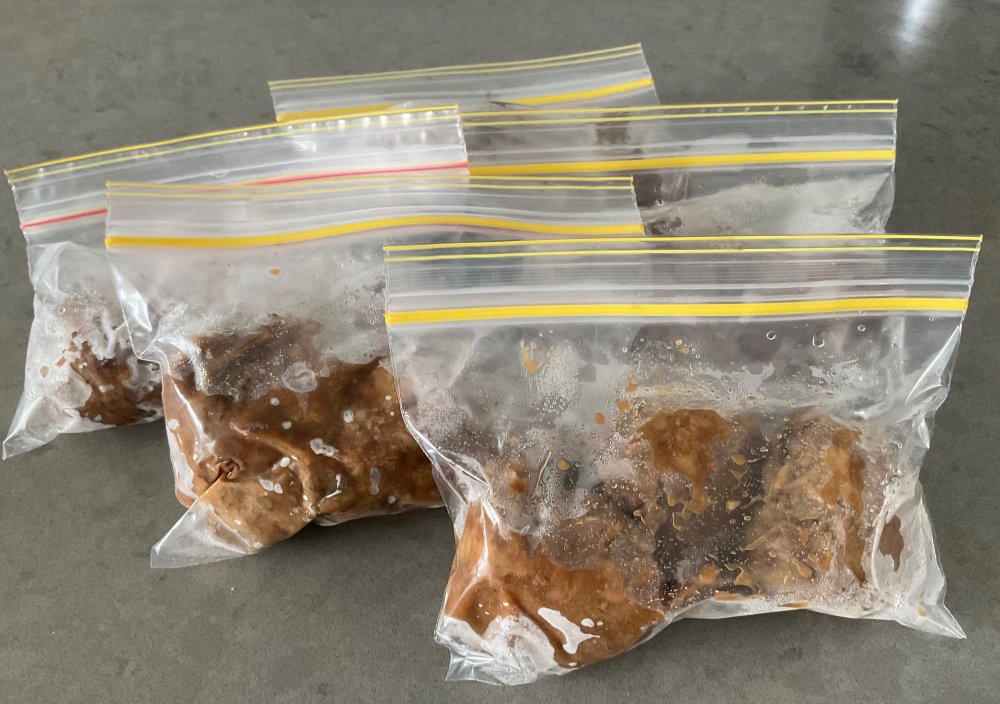
It’s always soup time @GreenTealael & yours looks yummy. Did another expedition into the depths of my freezer yesterday & found minced beef so I made rissoles with a little gravy. 500g gave me 6 meals of which I froze 5. Didn’t remember to take a pxt until an hour after they were in the freezer so they’re partially frozen in the pxt.
-
You’ve had a pretty major abdominal surgery so it isn’t unusual to still feel bloated or swollen for a good week or so. Your shoulder pain indicates you haven’t breathed out all your surgical gas yet. Even though liquids pass through your tummy more quickly, they could be making you feel bloated especially if you’re not used to drinking large amounts of fluids. Check your shake for sugar alcohols (end in ‘itol’) as they can make you feel bloated. Lactose can also cause bloating. As for the abdominal pain, it may be the sex you had last night. It may have been too much at the moment. Remember all the sutures & staples holding your tummy together & all the muscles & other organs that were pushed & prodded during the surgery. We usually told just to go for short gentle walks in the beginning. I added a list of the symptoms of a leak below. If you are experiencing some of these head to your nearest medical centre. Check in with your surgeon if you are still concerned. All the best. Rapid heart rate Fever Stomach pain Drainage from a surgical wound Nausea and vomiting Pain in the left shoulder area Low blood pressure Decreased urine output