Start here
Where are you in your journey?
Choose the path that fits today. We’ll take you to the most useful discussions.
- GLP-1 medication Zepbound, Wegovy, access, side effects, progress, and support.
- Before surgery Compare procedures, plan ahead, and get honest pre-op answers.
- Post-op Recovery, food stages, symptoms, and support.
- Long-term Regain, labs, habits, and life after the honeymoon.
- Revision Explore revision options, complications, and next steps.

catwoman7
Gastric Bypass Patients
-
Joined
-
Last visited
Everything posted by catwoman7
-
that's really common when you're early post-op. It eventually resolves for most people. sometimes it can be low blood sugar, and sometimes it's due to orthostatic hypotension (low blood pressure - which makes you feel especially dizzy or light headed when you're going from sitting or lying down to standing up). If yours IS worse when changing positions, it's probably the latter. Getting up slowly helps a bit... https://www.mayoclinic.org/diseases-conditions/orthostatic-hypotension/symptoms-causes/syc-20352548
-
in addition to the dreaded two-week pre-op diet, I had to do a six-month supervised diet as required by my insurance company. I could do it with either my PCP or a registered dietitian (I chose the latter). She had me eating something somewhat similar to the way I'd be eating once I was a couple of months out of surgery - at least 60 grams of protein, nonstarchy vegetables, small portions of fruit and/or complex carbs. She had me at 2000 calories - which for me at that time was super low, since I was used to eating more like 3000 (now, six years after surgery, 2000 calories would be a huge blow-out for me - I normally eat around 1600-1700 - but it was a comfortable level for me when I was pre-op - and certainly much lower than what I was used to). So maybe something like that? Work on increasing your protein and lowering your carbs - and focusing more on the "good" carbs (fruit, vegetables, whole grains) and avoiding or limiting the not-so-good ones. Once you get through all the initial restrictions and are eating somewhat normally again, that's the way you'll most likely be eating...for life, really...
-
I can barely see my scars anymore on my lower body lift (had it three years ago). Or really on my breast lift, either. I do have some scars on my arms, but they're not too bad. Better than I expected - because I'd heard that arms tend to scar worse then some other areas.
-
there are usually fairly large drops the first month or two, but then it slows down quite a bit. More like what you'd expect on a regular diet. After the first month, I lost about 8-12 lbs a month until maybe month 7 or 8, then I dropped down to about five pounds a month, and after the first year, it really slowed down to a crawl - a couple of pounds a month. I finally stopped losing at around 20 months out. of course, some of this depends on your starting weight, age, gender, genetics, metabolic rate, etc - but it does seem to be the general pattern, at least...
-
I haven't (I'm not any psych meds), but I've been hanging out on bariatric forums for the last seven years, and many people are on them. They sometimes have to adjust your dosage, but that's about it..
-
water aerobics, biking, and various youtube walking videos (I especially like "Reps to the Rhythm")
-
it's hard to find a surgeon these days who'll place one. Too many people had too many issues with them - it seems like a lot of people have had them removed.
-
sorry to hijack the thread - but a 20 lbs loss the first month is very normal. Most of us lose somewhere in the 15-25 lbs range the first month - so you're right in the middle of that!
-
anxiety before surgeries (any surgery) is pretty common...I always freak out before any surgery I've had. And they've all gone off without a hitch. first, morbidity rates on weight loss surgeries are really low. It's 0.3% for bypass, even lower for sleeve (not sure the exact percentage for sleeve since I had the bypass - but sleeve is lower). So there's a 99.7% chance (or greater) that you're NOT going to die - and those are excellent odds! Even better than hip replacement surgeries, which people get all the time. Weight loss surgeries have improved tremendousy over the years and they're no longer the scary, risky things they used to be. They've really become pretty routine at this point. I don't think most surgeons use catheters for weight loss surgeries, because unless you have other issues going on in there that they have to deal with, the surgeries are short. My bypass took a little over an hour - sleeve surgeries are typically even shorter. I DID have a catheter for two of my plastic surgeries, but then I was under for over four hours with those. The catheter wasn't any big deal - but no, most of us don't have one for weight loss surgery. the surgery won't fail as long as you follow the rules and guidelines. It'll work like a charm. But you do need to get the binge eating under control, because that could sabotage your efforts. They'll probably have you meet with a psychologist prior to surgery (that's very common...), but you may want to continue meeting with a therapist even after that because the binge eating WILL hinder your results if you can't get on top of it. Many of us have worked with therapists and found it very helpful. I can't speak to the being too young part, since I had surgery at age 55 - but like others, my only regret is that I didn't have it sooner.
-
yes - those first few weeks can be tough. But you'll get through it and things wlll get a lot easier.
-
oddly, it doesn't happen (or if it does, it's not common). The surgery resets everything - might have to do with hormonal changes, although I'm not sure.
-
I felt the same way. Overweight in my teens, obese in my early adulthood, morbidly (or super morbidly) obese once I got into my 30s. And then suddenly normal weight once I hit my late 50s. It's definitely bizarre - but it'll happen if you really work the program!
-
the closer you are to a normal BMI, the tougher it is to take off weight. That's because you're already pretty much at an equilibrium (calories in - calories burned) when you're normal weight - or pretty close to it. The last 20 or so lbs are always a bear to take off for most people. My last 20 lbs took FOREVER to get off - and now, slight regains are as well. and it's not just us. I remember so many times sitting at Weight Watchers meetings when I was pre-op and super morbidly obese, rolling my eyes at these normal weight - or slightly overweight - women b**tching and moaning about how hard it was to lose 10 lbs. Yea right - try losing 100, people. Now I totally get it....
-
i've been doing the annual Reclast infusions as well. So far, so good...
-
the intestinal part of it (that you got - since you already had the sleeve) is the malabsorptive part. You won't absorb everything you eat - that's what makes that surgery really powerful. And I agree with NovaLuna - they probably didn't see any issues with your sleeve. Plus I believe with virgin SADI/DS surgeries, they typically make the sleeves a little larger than they do with a stand-alone sleeve -- so your sleeve was probably more than adequate for the surgery.
-
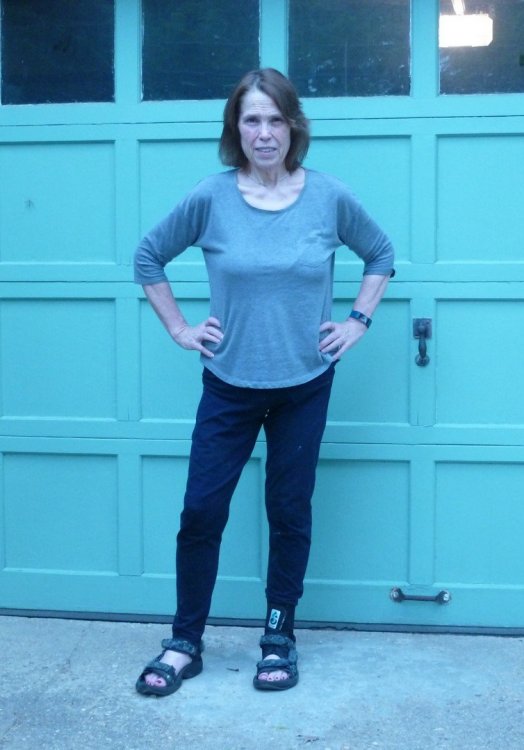
it varies a lot - depending on your age, how overweight you were, how long you were overweight, for example. You have your age going for you, so like Lynnlovesthebeach said, it probably won't be as bad as it is for someone in their 60s. I had surgery in my late 50s and lost over 200 lbs. I had tons of loose skin (which has since been removed), but even before it was removed, it was easy to hide in clothes. I was the only one who knew it was there (well, and my husband and doctor, of course). Here is a picture of me BEFORE I had it removed. As you can see, it was very easy to hide. You'd never know that I looked like a Sharpei puppy under those clothes - but I did!
-
they'll have you taking calcium and vitamin D after surgery (probably for life), so that usually helps to prevent it. So does healthy eating and weight-bearing exercise (e.g., walking, running, weight lifting...) I have osteoporosis, but I'm in my 60s and also, it runs rampant in my family (or at least in the women). I don't know how much of a factor my bypass was (if at all) since I didn't have a baseline done before surgery.
-
I eat English muffins occasionally - but not sure if I could have the first year or so. Even now I still occasionally have issues with some bread products. Some sit in my stomach like a brick. You could always try again another time.
-
most of us hated the pre-op diet. I'd consider myself lucky if I were you! Unless you REALLY want to do it... not all clinics require it -- so yours isn't unique. I thought it was the worst part of the whole ordeal..
-
I just take drug store vitamins. I've been taking Centrum Silver (or the generic equivalent from Walgreens or CVS) since my surgery six years ago. I took the chewable version for the first few months, then switched over to the tablets. You have to take two a day to meet the requirements. as long as you're meeting the American Society for Metabolic and Bariatric Surgery requirements, you should be fine. Here it is (you may have to scroll down a ways to find the chart with the requirements): https://asmbs.org/app/uploads/2017/06/ASMBS-Nutritional-Guidelines-2016-Update.pdf
-
ditto what all the others said - it's an average, and you'll find plenty of people who fall on either side of that. It includes people who don't do well because they don't follow the guidelines - and those who are super committed and are very successful. If you're really committed and follow the rules, you'll likely lose more than that.
-
I just did what I could to avoid getting it (masking, social distancing, handwashing, and getting the vaccine as soon as I was eligible), because realistically, that's all anyone can do. You don't have control over other things - and if you do all of those things, your chances of getting it - or getting a bad case of it - are greatly reduced.
-
the other posters are right - it's almost certainly due to water retention, constipation, or hormones. There's no way you could gain 5 lbs of true weight in three days unless you've eaten 17,500 calories more than what your body needs (since it takes 3500 calories to gain one pound - so 17,500 for 5 pounds)
-
there are some medical conditions that would make one surgery more appropriate for you than the other, the most common one being GERD. Most GERD sufferers are advised to go with the bypass, since that often improves it (if not cures it), whereas there's about a 30% chance that sleeve can make that worse. Since you have GERD, your surgeon will probably recommend that you go with that. Aside from certain medical conditions, it really comes down to personal preference. Both are good surgeries and you'll find plenty of people who've been successful with both. I had GERD, so I went with bypass on my surgeon's recommendation. I've been really happy with it.
-
most meds aren't an issue after gastric bypass. The only problematic ones I can think of are NSAID's and extended release formulas. I don't think I've ever heard of anyone who's had issues with antibiotics.


.png)