Start here
Where are you in your journey?
Choose the path that fits today. We’ll take you to the most useful discussions.
- GLP-1 medication Zepbound, Wegovy, access, side effects, progress, and support.
- Before surgery Compare procedures, plan ahead, and get honest pre-op answers.
- Post-op Recovery, food stages, symptoms, and support.
- Long-term Regain, labs, habits, and life after the honeymoon.
- Revision Explore revision options, complications, and next steps.

Arabesque
Gastric Sleeve Patients
-
Joined
-
Last visited
Everything posted by Arabesque
-
It’s okay. You recognise what happened & why. This puts you ahead of someone who denies it. You’ll know how to handle similar situations in the future better. And having a few twisties (oh the memories - cheese only never chicken) as a treat now & then is ok. You have to be able to live & enjoy your life. Now the important question: which show bag is your favourite? Bertie beetle? Fredo frog? I always got the snakes alive bag. Actually I recently had the same discussion about work putting arbitrary restrictions on when you can eat & forces your body to metabolise food & function in ways that may be unnatural for you. I’ve never had to do night shift (don’t know how you do it), but now I don’t have to get up & eat breakfast at 5/5:30am, I feel much better in myself. My body seems happier eating breakfast at 9ish. While I eat 99% of the time to a schedule, it’s the routine my body likes. My body clock very much responds to daylight so not getting up in the dark half the year is more energising too.
-
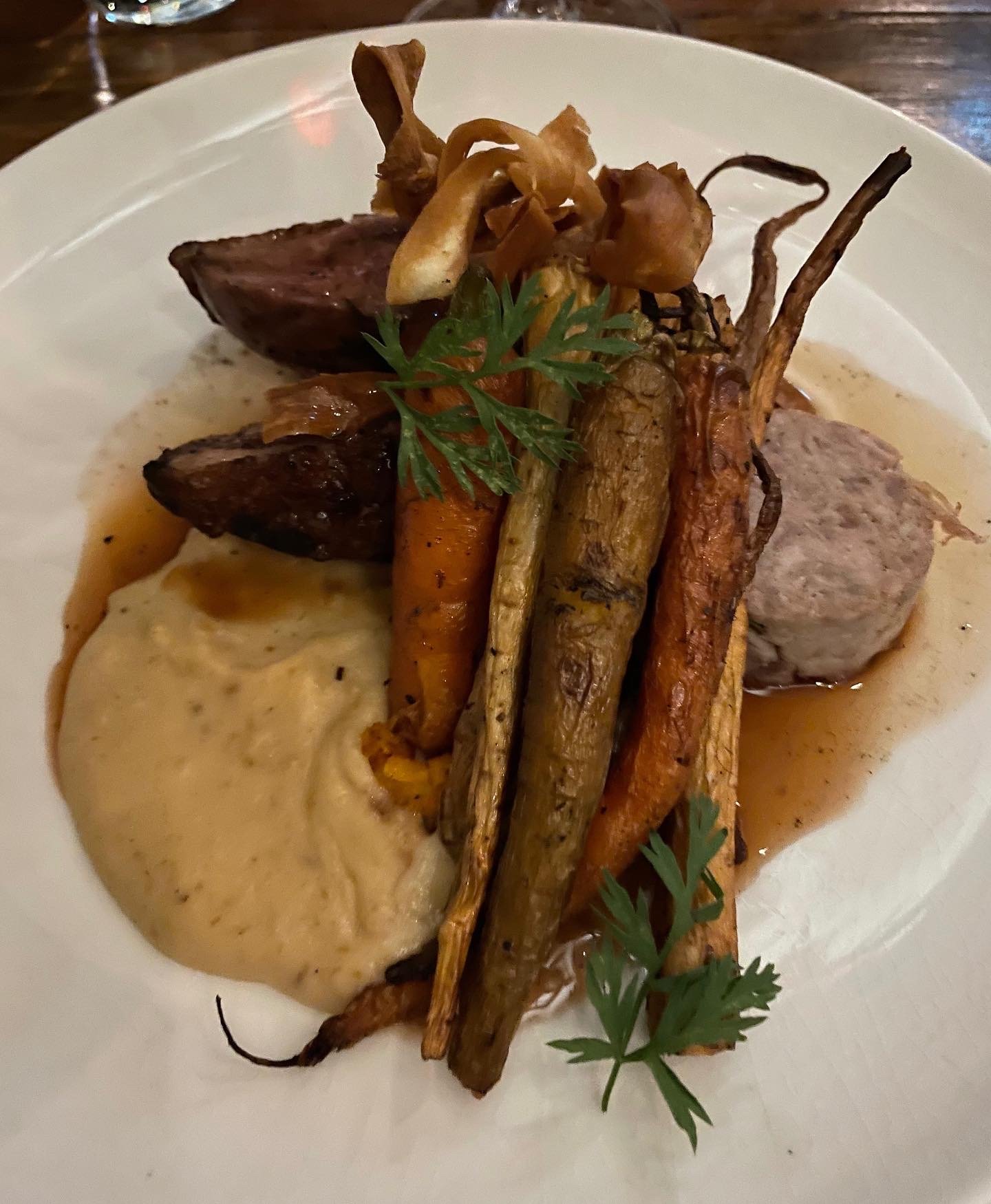
Dinner out with my colourist & her husband. Pre dinner gin & basil cocktail at local boutique hotel followed by dinner at nearby restaurant. Started with Brie baked in wood fire coals with fennel jam & fermented garlic honey. It was delicious. Wanted to scoop it up in spoonfuls but I used two small pieces of lavosh which sat ok. Then duck breast with puréed parsnip & baby carrots. Also sipped a glass of a lovely Grenache which I sadly couldn’t finish. I ate almost one piece of duck & 1/3 of the purée & carrots & have the leftovers for dinner tonight. Yippee! Lots of young beautiful girls at the hotel. All dressed the same, with their matching laminated brows, lip & check fillers, lash implants & blonde hair. All mirror images of each other. Not an individual amongst them. Sad really.


-
Be careful with nuts. They’re often not allowed for a couple of months. Check your plan first.
-
Were you given an plan with recommended foods to eat or avoid by your surgeon &/or dietician? If not ask your dietician & medical team for a list. Generally, we’re advised to avoid breads, rice and pasta because they swell in your tummy filling you quickly, and are nutritionally poor. So sushi, tortillas etc. would be out. Focus on getting your protein in first, then some vegetables, then a little fruit &/or carbs - look for low processed whole or multi grain as permitted on your plan - if you can. For most of us by the time we ate our protein then a couple of bites of vegetables, we were done. By 8 weeks I was eating all meats (soft white fish, smoked salmon, chicken, beef, pork, lamb). When we say we can’t tolerate a specific food it can be that you feel nauseous, or it sits heavily in your tummy & causes a general discomfort, it may taste or smell awful, it may be too dry or coarse & feel like it gets stuck & you get the foamies or you may bring it up. It occurs because our tummies are so sensitive after the surgery - healing & then getting used to foods again. But it doesn’t mean you won’t ever be able to eat that food. It’s really a temporary thing. Sometimes a couple of days or a week or so later it’s fine. Also you may be able to eat something without issue for weeks then one day your tummy says no, not today. Then the next day it’s all good. I called my tummy a petulant, tantrum throwing two year old for a couple of months. Yes, chicken can be too dry especially breast. Try thigh instead. It’s way more flavoursome & moist. If beef sits well, eat beef. Some struggle with salads to begin because they can be coarse & the leaves can seem like they get stuck & often they’re not on your plan for a couple of months.
-
The variations in answers to your questions occurs because we all heal & recover differently. For example,e, some return to work after a week, others take two or three. I took four but my energy levels were very low as was my blood pressure but my recovery is always slow. Your surgeon may do things differently too. Like, some surgeons send their patients home that afternoon. Others say stay overnight. Mine had me stay two nights as I lived alone. I ended up staying three nights as my back went into spasm & apparently my colour was poor. Have to admit I’m glad I threw in an extra pair of pjs & knickers. Ask your surgeon about the length of the surgery, expected length of your hospital stay, what to expect when you get to the hospital, etc. The hospital may have different prep requirements too. I had an appointment at the hospital a couple of days before, weight, height & medical records checked & had an ECG, blood test, etc. They also gave me an antibacterial wash I had to use in the shower at home the morning of my surgery & had to wash my hair with it too. My surgeon (& his anaesthesiologist) were lovely. He always is. Joking with me as I waited outside theatre. They both saw me in recovery after surgery too. Time sort of moves weirdly because your nervous. I have no idea how long I was in the theatre waiting room but it didn’t seem long. Though it felt like ages when I was moved outside the theatre. Make sure you get all your over the counter meds (non steroidal pain meds, Imodium, non swelling soluble fibre like Benefibre, gas X, etc.), vitamins, a variety of shakes, broths, soups, etc, as per your plan, herbal or green tea, some electrolyte drinks or sachets, before you go to hospital. All the best.
-
I think it could be stomach acid too. Or spasming from the surgery. Menstrual cramps occur low in the abdomen. If you haven’t got a script for a PPI, try some over the counter antacids (liquid would be easiest this soon out from surgery) until you speak to your surgeon. If it’s surgical spasming, try a warm drink like herbal tea or broth or warm your water or protein shake.
-
Yep, the acid in tomatoes can be a bit harsh to begin. Were you prescribed a PPI after surgery (Nexium or Prilosec, etc.)? Many are. Any over the counter antacids should work if the heart burn is mild. Otherwise just avoid tomatoes for a little while.
-
As @ms.sss said it all evens out. You lost a large amount to begin then nothing with your stall but your average is still 4lbs a week. This is a great rate of loss. You should be jumping for joy. Don't worry about small gains. We all have a natural fluctuation. We women gain & lose just with hormonal fluctuations & fluid retention that actually have nothing to do with our true weight & how much fat we’re carrying. Plus our bodies can be just weird & react unexpectedly. Two weeks ago I literally peed every 30-60minutes all day long & peed a lot overnight. I felt like ever drop of fluid in my body was gone yet got on the scales the next morning & weighed a pound more. I should have weighed at least a pound or two less. Our weight loss graph is never a straight line. It zigs & zags up & down but as long as the general tend is in a downward direction you’re doing fine. PS - have to admit I imaged you eating a giant loaded burger at first too. ?
-
Does that on my iPad too. Spins for ages & nothing. So you try again & suddenly multiple posts appear.
-
The stomach is a muscle so yes it could be stretched but most experts say stretching your tummy is nigh on impossible. The physical restrictions of the surgery limit your ability to continually eat the copious amounts of food you’d need to consume over a long period of time to do it. Who wants to experience the discomfort/pain, the foamies or vomiting, etc. You can only eat what you can physically eat. I still have days when I can’t eat what I could the day before. Don’t force yourself to eat all of your recommended portion size if you don’t need it or you feel you’ve had enough. Listen to your body. You should always avoid eating more but can always eat less. You just may not be ready yet to eat at the recommended portions yet. We all do this in our own time. Remember you don’t have to eat everything on your plate. It’s why many of us often have leftovers in our fridge & freezer. Lol!
-
Sadly, as lovely as your outfit is @DaisyAndSunshine, you may have to say a fond farewell to it. It looks way too big for you all over. But how wonderful is that. Whoo hoo! Cute shorts @jami.1992. I was the same about shorts too. Showing my knees or anything higher was frightening. Now I own a couple of pairs. You certainly have the legs to wear them. Look how narrow you are @huskymama in your bright summery dress. Love how you said you’d ‘released’ 52 pounds. Lol!
-
Like @kristieshannon, I didn’t eat much either for a while. And food smelling or tasting awful isn’t uncommon either. But because you are experiencing pain on swallowing I wonder if you have a stricture. They do happen & can be repaired quite easily. Demand an appointment with your surgeon. They need to see you to diagnose that. If you track your food intake, take that information with you so they can see what you are actually consuming.
-
Unfortunately the closer to your goal, the slower your rate of weight loss. Some weeks it is like the scale barely moves like a stall. It can be very frustrating. A it if what happening is you are eating closer to what your body actually needs to function & you are nearing your new body set point (the weight your body is happy with). A thing to consider is that your new set point may not be the weight you want to be. To get to a lower weight you will have to work harder & then will have to continue to eat less & be more active to maintain at the lower weight. Have a chat with your dietician & medical team. And if it is a persistent stall, sometimes a small tweak is all that is need to kick start your loss again. Body dysmorphia affects all of us in some way. It can take a while to see ourselves as we are now & it can also be demoralising & disheartening. You may find it helpful to seek the support & assistance of a therapist. Many have found therapy has helped them a lot. Your surgeon &/or medical team should be able to recommend someone who can be of help. All the best.
-
Welcome back. Gerd can develop after sleeve surgery not bypass. Bypass is usually the solution to gerd. Dumping isn’t very common & it can be controlled by dietary choices. Avoid high sugar & high fat & you’ll be fine. I have a sleeve & have the odd case of foamies though sometimes just the first stages when I accidentally eat something too dry or coarse or eat too quickly. When I do it doesn’t last long certainly not an hour. I think it is a more common side effect of the band. It will be a no to NSAIDS with sleeve or bypass. They’re too harsh in your much smaller tummy. Post surgery you will likely be prescribed an opiate like tramadol. You may not need them or only need them for less than a week. You will need to discuss with your surgeon & other doctors alternatives to NSAIDs if you took celebrex for joint, back or other long term regular pain management. As to juice, it may be an individual thing as to whether you can tolerate the acid content of certain juices. Juices are often on the list of things to avoid because of their high calorie content. Remember a single glass of juice contains a number of serves of fruit - more than you would eat as whole fruit. Better to eat the whole fruit & get a broader range of nutrients & fewer calories than from juice alone. Plus the whole fruit is more filling. All the best.
-
A modern 80s flashback. Tube skirt & matching sweater. Back then I swear I had a wardrobe full of summer & winter versions of this outfit in every colour (yes, I once wore lots of colour). Had court shoes in the matching colours too. The belt is a 2022 twist because the top was a little long proportionally. PS. That’s not loose skin hanging over the belt. It’s the dense cotton knit fabric & me slouching a bit. ?? PPS - it’s damn freezing here.
-
How heartbreaking for you & your family. This will be a difficult & dark time for you all. Don’t be afraid or reluctant to seek help & support. Prayers.
-
Congratulations @SleeverSk.
-
I just swallowed my PPI from the beginning. Swallowing meds can be a struggle for a short time initially because of swelling from the surgery but you had your surgery a while ago so it should be a breeze. Yes, the delayed release may be an issue because of your bypass - it may not work as effectively but check with your surgeon. Some capsules should never be opened so check about doing that first. Look into esomeprazole. It’s the more recent version (basically the same with differences in the chemical structure) of omeprazole. Esomeprazole is supposed to have fewer side effects & work better. Worth a conversation with your surgeon anyway.
-
This is true. That’s why therapy & understanding why you eat is a vital component of this process for many people. In the US a psychological assessment is part of the insurance approval process. In Australia, your surgeon recommends pre &/or post surgery therapy sessions. The surgery affords many benefits that dieting &/or exercising alone does. It resets your body set point (the weight your body naturally gravitates to), boosts your metabolism, removes part of the area that produces the hunger hormone (ghrelin) & can affect the glp1 hormone that regulates hunger & the metabolism of glucose. There are also of course physical changes that restricts how much food you can eat. You will have to change how & what you eat. (Many change when they eat too.) The surgery affords you the time to establish new habits, discover new foods & to work out what way of eating works best for you. I’ve tried many diets & I’m pig headed enough to stick to them for months without wavering but I’d always eventually go back to how & what I usually ate. I’ve never been able to maintain my weight like I can now. I made a decision to cut out a lot of sugar (real, artificial, substitutes) out of my diet. I don’t eat highly processed foods, avoid a lot of carbs & never have fast food. This has been what works for me. It may not work for you or complement your lifestyle. I didn’t record my food intake & still don’t. I do random checks of my calories & regularly check nutrients & ingredients. The only thing I watch carefully is my protein. Some people find tracking very helpful but it isn’t for everyone all the time. Though you may be required to do it for a while to ensure you’re getting in the nutrients you need. But you have to be ready to do this. As I said it’s not easy. It was harder than any other diet I’ve done.
-
I didn’t count calories but did do random checks for my own curiosity. I was eating less than 300 the first month. Was around 800/900 when reached maintenance at 6months on a good day. I eat about 1400 now at 3 years (but I’m not very active). But that is me. You’ll notice a fair bit of variation in what people could do & what then what they need to do to maintain. Some plans really push to increase calorie intake while others like mine don’t. If your plan doesn’t specify specific caloric plan but you’d feel more comfortable & confident with what you’re doing with caloric advice, ask your dietician &/or surgeon for some additional guidance. Remember though, you can only eat what you can physically eat. Otherwise, focus more on getting your protein (& water) in & watch portion sizes & food choices.
-
I’d look into surgery in a neighbouring country. There are a few Europeans on the forum who may be able to make some recommendations. There are always negative stories & a friend of a friend stories. You can find them about anything. I recently read a story about the prevalence of fungal infections in people who to go to the large nail salons so … People who have good experiences don’t always shout it from the roof tops. We do here though. ? Sure, there can be hiccups & things may not go perfectly to begin but generally everything settles & works out in the end or can be remedied rather easily. Some issues arise because of complications from pre existing conditions too. Talk to people who actually had the surgery (like on here) if you can. You also get negativity from people who think the surgery is an easy way out. It is so NOT easy. They think if you just diet harder & be more committed to exercising you’ll lose weight. If it was as easy as just dieting & exercising you’d be thin now. We all would have been. The negative comments from family &/or friends are why some of us don’t tell people we’ve had the surgery. The potential for developing a drinking addiction arises in response to people not being able to satisfy their food addiction anymore so they turn to alcohol (or sex apparently). I’ve seen stats of 16% after bypass in the first year of which 6% had existing issues with alcohol. Stating a 60% statistic would only benefit the woman in the article’s business by scaring people. If you deal with the issues behind your food addiction your chance for any addiction transfer is negated. It is important to do the ‘head work’ to understand, manage & deal with the issues behind your eating habits, behaviours, cravings, etc. Many people seek the support of a therapist after surgery which benefits their weight loss success & maintenance. The hair loss lasts about three months. Your natural hair loss cycle accelerates in response to the shock of the surgery & your change & reduced diet. So the hair you shed is hair you would be losing anyway - just not as quickly. Your new hair is still growing but just at its usual rate. How many wrinkles you have is much like how much loose skin you will have. It will depend on your age, gender, skin elasticity, genetics, how long you carried your weight, etc. Yes, you likely will look more drawn & have a few additional wrinkles at first but a lot of this reduces in maintenance as your body resettles & you’re eating more & a more nutritious & balanced diet. My uncle told my mother I looked like death when I was near my lowest weight. Now, he tells me I look fabulous. I had a lot of fine lines that developed under my chin while I was losing but they almost totally disappeared in my second year. Sure my marionette lines are deeper & that’s from the skin that stretched from having a fat face. I have the face that is mine now. I have a jawline, a longer neck, cheek bones, & my eyes aren’t as hooded. A few wrinkles are nothing. I’d rather have a few wrinkles or loose skin than be obese & be compromising my health. Besides a little Botox or filler can always help with the wrinkles ?. Ultimately it is your decision. Keep asking questions so you’re as well informed as you can be. All the best whatever path you choose.
-
They ask you remove nail polish so they can see the colour of your natural nail to check your circulation. Also sometimes nail polish can affect the accuracy of the instrument that clips onto your finger to measure your pulse & blood oxygenation levels. All the best with your surgery & recovery.
-
Generally, it all depends where you carried your weight. You’ll lose weight all over but if you carried a lot in your tummy, this will take the longest to lose because you have more fat to lose there. If you carried more in your thighs & hips, this will be the area that seems to be the hardest to shift & will take longer to notice the difference. It will happen, just give it time.
-
As @catwoman7 said it could be related to all the craziness of your weight loss. Hormones & other things being released from your fat as you’re losing throwing your levels out. My cholesterol & liver function rose when I was losing then settled in the healthy range early in my second year. As for the ferritin levels it could just be you & you sit at a little higher level. You wont really be able to tell until your weight & everything else stabilises. If it is still high then, you can give blood. That’s how people with naturally high iron levels (hemochromatosis) manage it. But of course check with your doctors. Do you take an iron supplement? If so maybe chat with your surgeon to see if you can reduce it (like once every two days). Generally if your surgeon isn’t worried, you can breathe easily.
-
Whether you track everyday, occasionally or never, I think really depends upon what you feel most comfortable & confident with. I was never given a calorie target at any stage. When losing I’d do random checks of my calorie intake out of curiosity. I still do random checks. Same with portion sizes as it’s easy to get complacent &/or over or underestimate. I always check calories & portions sizes of any new food or recipe when I first introduce them into my eating routine. I’m also an avid checker of nutrition panels on all food stuffs I buy. The only thing I monitor closely everyday is protein intake because of my absorption issue.