




Start here
Where are you in your journey?
Choose the path that fits today. We’ll take you to the most useful discussions.
- GLP-1 medication Zepbound, Wegovy, access, side effects, progress, and support.
- Before surgery Compare procedures, plan ahead, and get honest pre-op answers.
- Post-op Recovery, food stages, symptoms, and support.
- Long-term Regain, labs, habits, and life after the honeymoon.
- Revision Explore revision options, complications, and next steps.

catwoman7
Gastric Bypass Patients
-
Joined
-
Last visited
Everything posted by catwoman7
-
We started off about the same weight, and at month 4 (I just checked my spreadsheet), I'd lost 52 lbs, so not much more than you. It seems to be pretty common to lose about 10 lbs a month for the first few months (although some people have a big drop the first month (I did not), which is likely a lot of water weight - before settling in at a slower rate of loss). After the first six months or so, I dropped down to maybe five lbs a month - and after I passed the year mark, there were some months when I only lost about two lbs. It took me about two years to reach goal. If you stick to your plan, the weight will come off, whether fast or slow. There are so many factors that influence your rate of loss - age, gender, body build, how muscular you are, your metabolic rate, how active you are, whether or not you lost weight before surgery, starting BMI, etc. The only things you really have any control over are how closely you stick to your food plan and how active you are, so if you do well with those two things, the weight WILL come off. I ended up losing over 200 lbs, so definitely don't lose hope! P.S. of course, if your scale actually weighs differently than the one at the doctor's office, well then there's that, too...
-
I had bypass 10 years ago. It cured my GERD. For most people, bypass improves if not cures it.
-
I had bypass ten years ago, and I've never dumped. Lots of others I know have never dumped, either. I used to know the percentages (I don't live and breathe this stuff like I did the first few years post-surgery), but I seem to recall it was something like 30% dump. You can control that by not eating a bunch of sugar or fat at one sitting, since that's what sets it off. DSers have a sleeved stomach, so I would think dumping would be pretty rare with them.
-
if you're sticking to your plan, then it's probably just the typical slowdown you experience as you get closer to a normal weight. I lost weight until month 20, but after the first year, it was S-L-O-W. Just a couple of pounds some months. So many times I'd think "this must be it", but then my loss would start up again. I'd look at the list above, too, though (Spartan's list) - he's listed some other potential reasons for it.
-
Hi - if you aren't able to get back on track alone, I'd seek out the help of a therapist. This is your big chance of losing a ton of weight, so you don't want to blow it. It'll never be this easy again! (not saying it's easy, but way easier than it has been or will be once you're past the so-called "honeymoon stage"). You need to take full advantage of that, so do whatever you need to do to get back on track!
-
you lost way more than I did in the first three months - and I started out around the same weight..
-
most people do have a rebound after hitting their lowest weight. Ten to twenty lbs is pretty common - but like others have said, some people don't gain back any at all and some regain everything. If you commit to keeping your eating under control for the rest of your life, though (not that you can never have an occasional splurge - but keeping things in control at least most of the time), it's very doubtful you're going to gain a ton of it back. It's definitely a life-long effort.
-
yes - it was probably total energy they were talking about and not BMR (it's been a while, so I don't remember exactly - other than there was a difference if you were formerly obese)
-
just a note on BMR - I've heard this from both a former dietitian of mine and from a nutrition class I took a couple of years ago at UW-Milwaukee on obesity and weight loss, so it's likely true (seems to be the case with me, anyway...). It's very common for formerly obese people to need to eat 300-400 calories less per day than a person of the same height/weight/activity level who's never been obese in order to maintain their weight. So in other words (and I'm just pulling this example out of the blue), if a calorie calculator tells you that it takes about 1800 cal/day to maintain your weight, if you were formerly obese, that could mean that for you, it's probably more like 1400-1500 calories to maintain. That being said, I do agree with some of the others that you may be underestimating your calorie intake since I would think you'd be losing weight at that intake level. It might be helpful to cut back by about 100 cal/day for a couple of weeks and see if the scale starts moving again. if not, cut another 100 calories for a couple of weeks. Rinse and repeat until the scale starts moving. I've had to do this a few times to get things moving..
-
actually, RNY CAN be reversed, but it's a complicated surgery and they only do it if someone has severe medical issues that can't be resolved any other way.
-
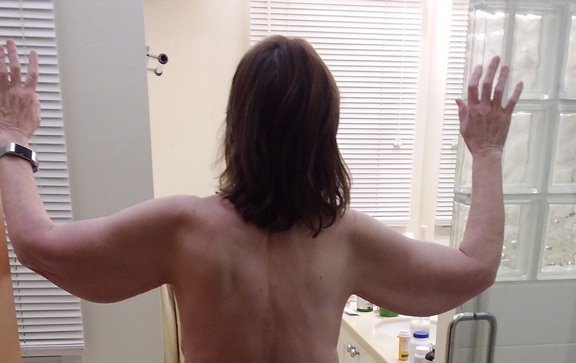
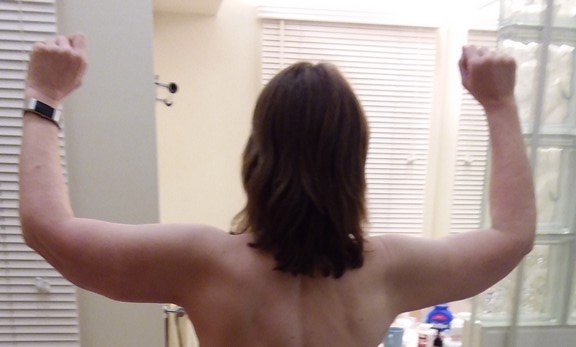
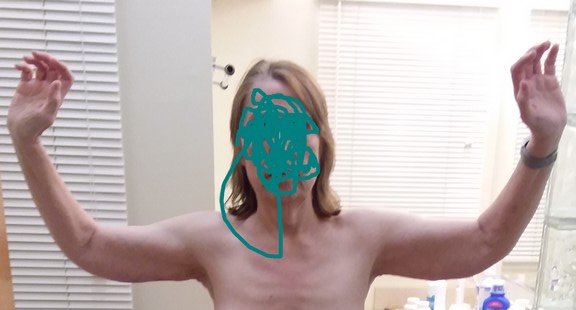
Yes - as Greentael (sp?) said above, your second set of photos give more context. Here are my before and afters. I forgot I had these on here.

-
LOL - I was just thinking that the OP's "before" brachioplasty pic looks a lot like my "after" brachioplasty pic! (of course I had major batwings - much worse than the OP's)
-
Leaks, if they occur, are almost always within days after surgery. Everything in your stomach should be well healed by now. I actually haven't heard of nutritional deficiencies in sleeve patients - you don't have malabsorption with that. I suppose if you ate crap all day you might have deficiencies - but I'm assuming you don't. Nutritional deficiencies can be an issue with the malabsorption surgeries (RNY, DS, SADI), but then again, if people stay on top of their vitamin regimen, they're pretty rare (well, except iron - some people don't absorb iron well from tablets or capsules so they have to get occasional infusions - but than can be the case with anyone - even if they've never had surgery). I do know a few RNY'ers who have to get iron infusions, but not many.
-
the only ones I had trouble with at first were those giant calcium tablets. I got some chews instead - problem solved! Once I was a year or so out I went back to tablets, but usually got the "petite" ones (I could definitely take the regular calcium tablets by then, but I preferred the "petite" ones)
-
how long have they been underweight? Many of us who make it down into a normal BMI range look pretty scrawny for a while, but then (also for many of) regain starts. I was really worried about how thin I was getting - now 10 years out I wish I wouldn't have worried about it. I've regained more than I wanted to (it's not awful - but I'm now "overweight" and would love to lose 10-15 lbs - but it seems next to impossible!)
-
Unless you have some type of disability, you should be able to do anything now - so as others have said, try out a few things to find one(s) you enjoy. You're a lot more likely to stick with something if you enjoy doing it. I love cycling and water aerobics. Cardio dance is also OK. I'm hoping after I have my hip replaced this spring that I'll start to enjoy long walks again, too!
-
wild fires unfortunately have become pretty common in North America (US plus Canada, too) the last few years, but this one is particularly bad because that area is so densely populated. it's very sad and tragic.
-
I had the whole shebang done several years ago, but it was really the front part that was really painful (probably because of the muscle tightening). I don't remember my backside hurting that much.
-
All food restrictions will be lifted once you're a few months out. There's nothing you won't be allowed to eat, but you'll need to be mindful of calories, portion size, and nutrition from here on out, otherwise you'll be at risk of gaining the weight back. I eat all of those things you mentioned..just in moderation (and some of them, I don't eat very often).. Do I ever splurge? Yes - but not often, and I'm right back at it the next day. honestly, many of my never-been-obese women friends eat the same way - they watch their portion sizes and don't splurge or eat really high-calorie or unhealthy things very often - just occasionally.
-
I'd do what works for me rather than them. Also you may not even get a date until after that anyway. As someone else said, it has to go through the insurance approval process. Even after mine was approved, they were scheduling a month or so out - and they gave me a couple of different dates to choose from. I actually asked if I could even do it later than the dates they were offering because I was working in education, and my supervisor said she preferred I wait until after the academic year was over (which was maybe another month out) - they said that was fine and gave me a couple more date options, one of which I went with. It all worked out in the end..
-
as usual, I agree with everything Arabesque said. A 10-20 lb bounce back regain is very common after you hit your lowest weight. It's your body settling in to where it's comfortable. You can always lose it again if you really work at it - although if that new weight IS your body's new "set point". it'll be a challenge to get back down there and stay there - but it's not impossible.
-
it's very unusual for "normal" weight loss patients (that is, those of us who aren't the size of the folks on "My 600 lb Life") to lose that much weight (the 30 or 40 lbs you mentioned) the first month. I have been involved nationally - both on forums and at conferences - with WLS for years, and I've never known anyone to lose that kind of weight (maybe 30 lbs - but even those folks are outliers. Forty pounds? Never). Most of us lose somewhere in the 15-25 lb range that first month, so you are right where you need to be. I lost 17 lbs my first month, and I started out at well over 300 lbs. I went on to lose 235 lbs (have gained some of it back, as most people do, but I'm still over 200 lbs lighter at nine years post surgery). Your loss is absolutely normal.
-
I would check with a doctor, but Bypass2freedom may be on to something. It could be Orthostatic hypotension. That can cause both temporary blurry vision and dizziness. It's due to low blood pressure and usually occurs when you stand up quickly. It's very common in the early months after weight loss surgery (used to happen to me, too). If you stand up slowly you can usually prevent it. But check with a physician regardless to be on the safe side (this might have been what was going on the other day when you mentioned you were dizzy, too)
-
It *could* be hypoglycemia. To prevent that, you're supposed to eat something about every three hours. Preferably a protein if it's WLS-related. Even a thing of yogurt is fine.
-
the kind of reactive hypoglycemia that some people get after bariatric surgery isn't necessarily related to diabetes. It can happen to non-diabetics, too (I'm not diabetic). I've also seen it referred to as "late dumping", because it tends to happen a couple of hours after you eat (as opposed to soon after, as is the case with regular dumping). I mentioned in my response above that my physician couldn't find anything wrong with me when she did the workup, but she told me to let her know the next time I had that experience. The next time was a couple of weeks later. I'd been at a retirement party and had a whole piece of cake (instead of a couple of forkfuls, like I used to have back in those days). A couple of hours later, there it was again - dizziness, etc. She said it was likely reactive hypoglycemia (AKA post-prandial hypoglycemia), and it may not have shown up at the workup because my glucose might have been normal the day I went in for that. Anyway, yes - it's not uncommon after WLS, . It often appears when you're a year or so out (although sometimes sooner...or later). They say to eat protein - or a something paired with a protein - every three hours or so to prevent it (I know it's orange juice or something similar for regular hypoglycemia - but she specifically said protein with this type - may be something to specific to the WLS-caused version)

.png)
