Skip to content
View in the app

A better way to browse. Learn more.

BariatricPal

A full-screen app on your home screen with push notifications, badges and more.

To install this app on iOS and iPadOS
  1. Tap the Share icon in Safari
  2. Scroll the menu and tap Add to Home Screen.
  3. Tap Add in the top-right corner.
To install this app on Android
  1. Tap the 3-dot menu (⋮) in the top-right corner of the browser.
  2. Tap Add to Home screen or Install app.
  3. Confirm by tapping Install.
  • Appearance

Join BariatricPal free

  • Ask your own questions
  • Reply and follow topics
  • Message other members
  • No cost, no spam

Set Point, Reaching Ideal Weight, Staving off regain

I'm a newbie and excited about my upcoming surgery and current lifestyle change. I'm looking forward to using this new tool. Dr. Matthew Weiner, A Pound of Cure, made some fascinating statements about results. He said words to this effect: Post-opers reach a certain "Set Point" weight and that's all. He said that what that point is is largely based on a number of factors including genetics and lifestyle. Initially, genetics is the major determinant of results and then lifestyle plays a more significant role in the long run as to whether or not you regain significantly. Has anyone out there reached and maintained a normal BMI? If you maintain a clean diet, have you staved of major regain? Interested in hearing thoughts from Post-opers on this subject.

  • Replies 12
  • Views 1.3k
  • Created
  • Last Reply

Top Posters In This Topic

Most Popular Posts

  • Healthy_life2
    Healthy_life2

    I'm a sleeve. four1/2 year’s out. I maintain in the 130's. I give myself a ten-pound bounce range. when the scale moves up, I go back eating my bariatric food plan to stay in range. I'm in ma

  • Healthy_Life2 is giving some really solid advice and feedback. I appreciate her comments. I am only 2 months out so can't comment on weight regain. I can say that I have made a complete 180 in my

  • You know there is a difference between "ideal" and goal weight right? Just to nerd out on you, "ideal" weight is a very specific metric based on pretty archaic insurance charts. And for women (d
Posted Images
Featured Replies

  • Popular Post
8 minutes ago, Kelise said:

Has anyone out there reached and maintained a normal BMI?

I'm a sleeve. four1/2 year’s out. I maintain in the 130's. I give myself a ten-pound bounce range. when the scale moves up, I go back eating my bariatric food plan to stay in range.

14 minutes ago, Kelise said:

Has anyone out there reached and maintained a normal BMI? If you maintain a clean diet, have you staved of major regain? 

I'm in maintenance phase. I eat mainly clean, I do indulge occasionally. My third year, my weight got up to 147. (still a BMI 24.5 normal range) had to dial in my diet to lose the weight. I'm back in the 130's

My two cents on regains. Weight gain can happen with any type of bariatric surgery.

Some factors in regain:

  • Complications from surgery
  • Medical issues and medications
  • pregnancy/menopause
  • Not weighing yourself regularly
  • Getting complaisant as the years pass
  • You will reach a point that you noticeably can feel less restriction with the sleeve (it has not stretched) Just because you can consume more food, does not mean you should. Its important not to go over your calories and macros for the day.
  • Stretching is rare. Get it diagnosed by your surgeon for a revision
  • Eating around your surgery. Grazing is consistently eating sever small meals of healthy and unhealthy foods. The total will be over your calories and macros. It’s as if you never had surgery. You can eat 3000+calories. YOU WILL GAIN WEIGHT
  • Ask for help if you have a gain (surgeons office, dietician and counselling) - Easier to lose a 20 pound gain than a 40, 60, 80, 100+

  • Popular Post

Healthy_Life2 is giving some really solid advice and feedback. I appreciate her comments. I am only 2 months out so can't comment on weight regain. I can say that I have made a complete 180 in my lifestyle choices. I am extremely diligent in following my post-op dietary plan. I track daily caloric intake using the MyFitnessPal App and then go over my macros in the evening to make sure I am on target. I wouldn't even call it a diet--because that's such a temporary thing. I am looking at this as a new lifestyle. I have deviated from the standard plan provided by my doctor (I did discuss it with him and my nutritionist) and I am following a very low carb keto style plan (although too high in protein intake to be a true keto diet). This type of lifestyle provides me with very clear guidelines of what I can and cannot eat--which makes choosing foods easy, I do track calories too and set a limit to how many calories I can consume in a day, but this isn't hard since I am usually very satisfied sticking to my plan. Even if my ability to eat more increases, I feel like I can make good choices that may increase the volume of food that I eat without causing me to over-consume.

When they say the sleeve is only a tool, they do mean it. Losing weight post-op is still a lot of work and requires a lot of discipline. The big difference is you are no longer fighting against your high set point, so instead of heating a plateau and suffering terrible hunger and cravings, you don't have that set point fight against you. The volume restriction is also helpful, but as Healthy_Life2 said, you can eat more frequently and undermine this process. I also now get up early in the morning to hit the gym before work and I love that "me" time. Even though this new and still "exciting" for me, it's a lifestyle that I can be happy with for the long term. I do not miss sleeping in late or eating carb heavy foods. I hope I still feel this way 2 or 5 or 10 years from now, but I am definitely happy right now.

I can say that you need to be mentally prepared to make major lifestyle changes after you have the surgery (before as well!!). You need to have a healthy lifestyle plan in place and be 100% committed to following it through after surgery. I think the people that commit to following a healthy lifestyle plan will be successful long term. The people that only follow the post-op plan "most of the time" and "only cheat a little" are probably not following the plan very much at all and are cheating a lot!! I have gone to a few support group meetings and there are so many people that show up that can't understand why the weight isn't coming off them, while their friends lost so much. After talking more, it turns out that, as a result of surgery, they cut down their portions of crappy processed fast foods and other junk foods, but they continue to eat the same crap they ate before surgery (just less of it). That's not how you get down to a 25 BMI!!! You have to use this opportunity not only to cut down on your portions, but change your food and lifestyle choices. The people that make these changes and stick to it don't seem to have issues with regain (other than the normal 5-10 pound fluctuations that should be expected).

  • Popular Post

You know there is a difference between "ideal" and goal weight right? :)

Just to nerd out on you, "ideal" weight is a very specific metric based on pretty archaic insurance charts. And for women (don't know for men), you use this formula to calculate it:

100lbs for the first 5 feet.

5lbs for every inch over 5 feet.

So for me, a 5'4" woman of average build, I have a theoretical "ideal" weight of ABOUT 120lbs give or take.

I asked my cardiologist if 120lbs was a reasonable goal. He said, he doubted very seriously if I could get there and that he didn't really think it is do-able for most people, not just me.

But the wls peeps use ideal weight to calculate your theoretical expected weight loss for your type of surgery and they also compute a theoretical "goal range" for most of us--whether or not they are willing to disclose that information, they still calculate and track it for each of us.

My theoretical goal based on my ideal weight and based on my surgery was 156lbs. My 1st goal for myself was 150lbs. Now I'm going for goal #2 140lbs which puts me slightly under the mark on a weight chart where I'm in "normal weight range". My goal #3 is to get to 130lbs. My doctors think I should be able to do that if I really apply myself. So even at 130lbs as a goal, and even though I'm a "normal weight" for a woman my size, and even though I will have met and exceeded the expected/targeted % of expected weight loss...I will still be 10lbs heavier than my "ideal weight."

This morning I am 32% fat (different than BMI) by Tanita and that fluctuates wildly with hydration. I go from 26% fat in the afternoons to 32% fat in the mornings. So by that metric, I have about 47lbs of fat sitting on my frame. Of that 47lbs of fat, I have what "they" figure is 13-14lbs of ESSENTIAL fat. That's the fat I must have on my body to continue to live. We all have something like that amount of essential fat. So accordingly, I have about 47-14=33lbs of excess fat left to lose. I think I can lose about 20lbs, but the rest of that seems impossible. And losing 20lbs still doesn't get me down to my ideal weight.

Can I maintain it? I believe I can as long as I take each day as a new chance to live healthy and eat my best and exercise. I too am low carb/defacto keto, and get only "adequate protein". I also eat very low glycemic foods and try to get my daily 20g of fiber into the mix.

Sorry for the book. (Oh I'm nearly 12months out and have lost 140lbs from my recent high weight.)

Edited by FluffyChix

@FluffyChix

Good point.

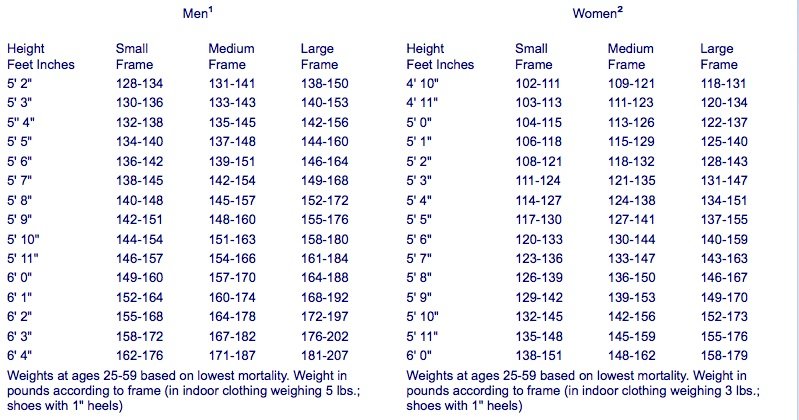
Not sure how accurate this ideal weight chart is.

Metlifetable2.jpg

Short answer: It depends.

In extreme weight loss, your metabolism will likely function at a diminished level for the rest of your life. As in, eating 2000 calories a day may without regain may never be an option. There have been extensive studies on this, and you can actually work with your doc to gauge your nutritional needs as you progress. Nearly four years out, my metabolism simply doesn't operate the same, having spent my life over 300 lbs. If I eat more than 1200 calories a day, I will begin to regain. My needs are different now, and that's that.

  • Author
On ‎2‎/‎5‎/‎2019 at 8:12 AM, Healthy_life2 said:

I'm a sleeve. four1/2 year’s out. I maintain in the 130's. I give myself a ten-pound bounce range. when the scale moves up, I go back eating my bariatric food plan to stay in range.

I'm in maintenance phase. I eat mainly clean, I do indulge occasionally. My third year, my weight got up to 147. (still a BMI 24.5 normal range) had to dial in my diet to lose the weight. I'm back in the 130's

My two cents on regains. Weight gain can happen with any type of bariatric surgery.

Some factors in regain:

  • Complications from surgery
  • Medical issues and medications
  • pregnancy/menopause
  • Not weighing yourself regularly
  • Getting complaisant as the years pass
  • You will reach a point that you noticeably can feel less restriction with the sleeve (it has not stretched) Just because you can consume more food, does not mean you should. Its important not to go over your calories and macros for the day.
  • Stretching is rare. Get it diagnosed by your surgeon for a revision
  • Eating around your surgery. Grazing is consistently eating sever small meals of healthy and unhealthy foods. The total will be over your calories and macros. It’s as if you never had surgery. You can eat 3000+calories. YOU WILL GAIN WEIGHT
  • Ask for help if you have a gain (surgeons office, dietician and counselling) - Easier to lose a 20 pound gain than a 40, 60, 80, 100+

AWESOME advice! Thanks!.

  • Author

Great distinction and metrics. THANKS.

  • Author
19 hours ago, BarrySue said:

If I eat more than 1200 calories a day, I will begin to regain. My needs are different now, and that's that.

@BarrySue That's invaluable info. How did you arrive at that number, 1200 calories? Was it through trial and error?

  • Author
On ‎2‎/‎5‎/‎2019 at 12:14 PM, FluffyChix said:

But the wls peeps use ideal weight to calculate your theoretical expected weight loss for your type of surgery and they also compute a theoretical "goal range" for most of us--whether or not they are willing to disclose that information, they still calculate and track it for each of us.

@FluffyChix Thanks for that. I loved the book! Very helpful! Hmmm. I wonder, is this tool something we can access online? I've heard different surgeons reference it saying things like: For Gastric Bypass we can estimate pretty accurately but not as much for VSG. Is that a calculator you've ever seen?

They use statistics.

I can't remember the stats right off hand. You can google it though! :)

On 2/7/2019 at 4:03 PM, Kelise said:

@BarrySue That's invaluable info. How did you arrive at that number, 1200 calories? Was it through trial and error?

I had a resting metabolic rate test done, as well as other assessments/bloodwork/etc. Similar testing on metabolic output has been done on the previous contestants of Biggest Loser, and it's pretty much universal for those who go through extreme, rapid weight loss. It's a huge part of why regain happens. My body has changed significantly in that I am constantly cold, and my thyroid function has diminished (not to levels where I need supplements, but the low range of normal).

On 2/7/2019 at 2:03 PM, Kelise said:

@BarrySue That's invaluable info. How did you arrive at that number, 1200 calories? Was it through trial and error?

For me it was more than my resting metabolic rate and total daily energy expenditure (TDEE) . The calories/macros are not a one size fits all. Body physiology, medical issues, age, hormones and medications can change your weight loss/maintaining calories and macros. It took me some trial and error to dial in what works for me.

I had to go by the calories recommended and then dial them back by 100cals to see where my body starts losing weight. Dial them up again to see where I maintain.

TDEE was way off. It set my maintenance calories to 1,925 Weight loss calories 1,426

Join the conversation

You can post as a guest; create a free account to track replies, follow topics, and be part of the largest weight loss surgery community.

Join the conversation

You can post now and register later. If you have an account, sign in now to post with your account.

Guest
Reply to this topic...

Account

Navigation

Search

Search

Configure browser push notifications

Chrome (Android)
  1. Tap the lock icon next to the address bar.
  2. Tap Permissions → Notifications.
  3. Adjust your preference.
Chrome (Desktop)
  1. Click the padlock icon in the address bar.
  2. Select Site settings.
  3. Find Notifications and adjust your preference.