




A beginner's guide to fills
- Replies 42
- Views 4.9k
- Created
- Last Reply


Most Popular Posts
-
Kathy, don't eat 2 hours prior to your fill. But it's o.k. to drink up until then. You'll do fine!
Posted Images
Featured Replies
Join the conversation
You can post as a guest; create a free account to track replies, follow topics, and be part of the largest weight loss surgery community.
. . . by that I mean BY a beginner, for other beginners. I had my first fill today. I found other descriptive posts very helpful in answering my questions and allaying my fears, so I thought I'd post a little step-by-step guide of my own, in case it helps any other readers who wonder what a fill involves and feels like.
First of all, I should mention that I was banded in Mexico and am getting aftercare in the US. This was made relatively easy because (1) I live in a big city, and (2) one of my surgeon's former students has a large, well-established Lap-Band practice here, and this doctor agreed to do my fills for a fraction of what he usually charges other docs' patients ($250 vs. $1000).
My surgeon, Dr. Rumbaut, had told me that I'd probably want a fill after six weeks; no matter what, he said, I shouldn't get one any earlier, and I may not need one until later. The day after my six-week anniversary I started feeling hungrier, and was able to pack away more food than before. I figured I should at least get checked out.
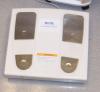
My appointment was at 2 pm today. I arrived at Dr. Horgan's posh Michigan Avenue office 15 minutes early, completed a new-patient info form and a questionnaire about obesity-related health problems and whether I'd noticed a change since banding, and just after 2 pm I was shown to an examination room where an assistant, Michelle, weighed me on a body-composition scale (photo #2 below) and took my pulse and blood pressure. I was asked to change into a giant hospital gown. (I should mention that both the gowns and many of the waiting room chairs are sized to accommodate very large people. Someone was thinking ahead.)
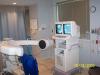
I asked Michelle if I could take pictures, and after an initial hesitation she said yes, and suggested that I ask for a duplicate copy of my fluoroscope image. She then led me to the room holding the machine (photo #1). In a few minutes Dr. Horgan and a male technician came in and briefly explained the procedure. I should mention that, except for the gown replacing my blouse, I was wearing all my clothes. Dr. H asked me to lower my trousers so that he could get access to the port, which in my case is a few inches above my left hipbone. He guided me into position in front of the fluoro machine. I remained standing the entire time, and never actually touched the equipment. To my disappointment I realized that I would not be facing the image of my belly, which (weirdo that I am) I was kind of looking forward to. So far, easy as could be, no discomfort of any kind.
Next, Dr. H sprayed a "freezing agent" near my port; I forgot to ask what it was. The freezing agent really did feel cold, and it looked as if a half-dollar-size spot on my belly had been in the back of a refrigerator that needed defrosting, little ice crystals and all! Still no discomfort. He asked me to take a swig of a thick white barium drink. It wasn't as bad as I expected (the technician joked that Starbucks was selling it, but that's pushing it) -- just a little chalky, with a slight vanilla scent and taste. The barium makes its way down the esophagus to the stomach (and, later, beyond) and allows the technician to see a rough outline of the patient's insides.
At this point I noticed Dr. H preparing a big hypodermic needle. Yikes! After adjusting my position, he aimed right for the port. I won't lie -- I definitely felt it. I know many other bandsters don't even notice the needle go in, but not me. However, it wasn't bad, and I think if I hadn't expected the entire procedure to be a total breeze, it probably wouldn't have bothered me at all.
Unfortunately I couldn't take a picture of the needle going into my belly, because I had to hold my arms straight down at my side -- and I sure didn't want to ask the doc to drop that giant needle and pick up my camera!
I think it was at this point that I took another swig of the barium drink so they could monitor the response of the band and my body. That needle was definitely in, and the doc injected some saline. I blithely thought I'd get 1.5 cc, since that seems to be average, and so far I'm your average bandster. Nope! First I was injected with 1.4 cc, then as the two guys watched the fluoro, Dr. Horgan said, "Oh, that's too much. Let's take out .2." So he did. So here I am with 1.2 cc of saline in my Inamed band, which Dr. H said should give me good restriction.
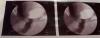
I did get a copy of my fluoroscope picture (#3). Hey, I've had less flattering photos! By the way, the small bit highlighted by the ink rectangle in the left image is my band, and the dark hairy-looking bit is the barium drifting through my stomach. I had to ask.
Well, I'm on liquids for 48 hours, then onto the real bandster eating routine. Dr. Horgan said I should lose two pounds a week. When I said I didn't mind losing more slowly, he was adamant, and said if I didn't lose those two pounds every week I should give him a call. He wants me to see him in another two months -- sooner if I have trouble. And in case this initial fill is too tight or too loose, I can have it readjusted for free as long as I do so within a week.
One last thing I can't resist adding: Dr. H asked me why I had surgery in Mexico. "Financial concerns," I said. "What kind?" he asked. I was taken aback. "Well, it's a lot cheaper in Mexico," I shrugged. He didn't have a response to that!
Good luck to everyone getting their first fill -- it's not bad, and the whole thing, including paperwork and tests, took about 45 minutes.