
James Marusek
Gastric Bypass Patients
-
Joined
-
Last visited
Everything posted by James Marusek
-
Several months after surgery I began using protein bars instead of relying on protein shakes. I found Quest protein bars to be an excellent choice. They had high protein, low sugar and high fiber [to help with constipation issues]. They also tasted good and came in a variety of flavors. They came in handy in getting in the daily protein when I was on the go and couldn't drag around my Ninja blender to make my protein shakes. So a few minutes ago I received an email from GNC saying they were giving away free Quest Hero Protein bars for today only. So I thought this might be good information. But then I pulled up a food label on these new protein bars. They contain 12 grams of sugar. That is way too much sugar. Comparing that with the original Quest bars that contain only 1 gram of sugar.
-
Good luck on your surgery and check back with us when you are on the other side and let us know how it went.
-
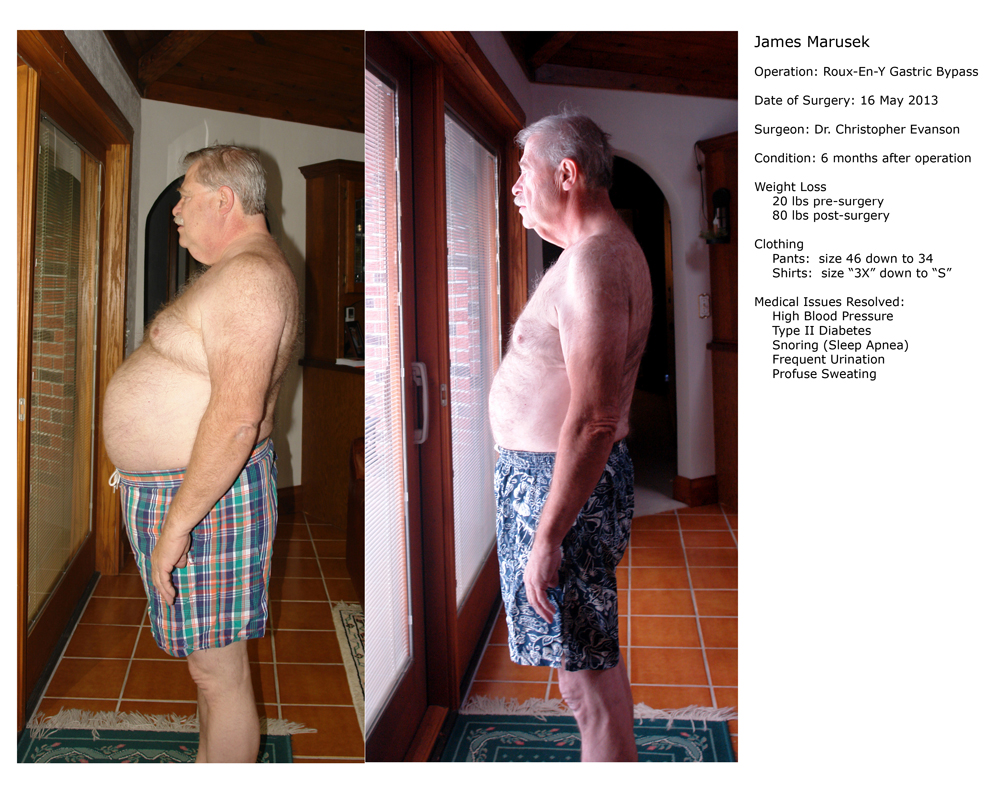
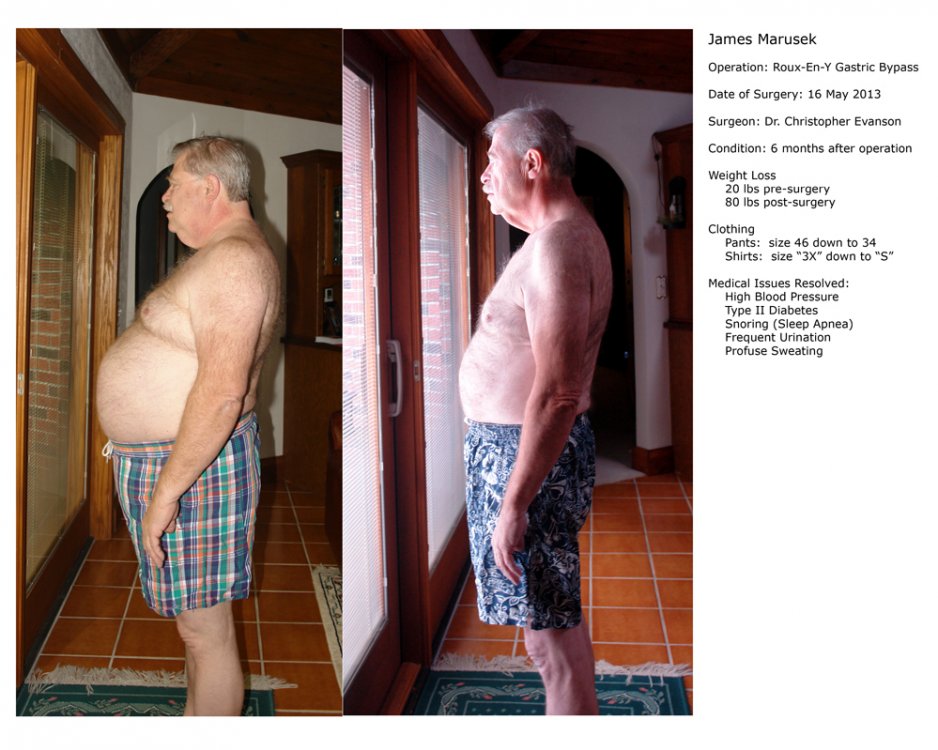
Many times prior to surgery we are unaware of the extent of our obesity. We do not really look at ourselves in the mirror. We avoid being in photographs. Therefore, it isn't obvious how much weight we have really lost when the pounds begin to drop off. Before I had surgery, I took an very unflattering photograph of myself and then after surgery at the 6 month mark, I took another as a comparison. I used the same pose.
-
The three most important elements after RNY gastric bypass surgery are to meet your daily protein, fluid and vitamin requirements. Food is secondary because your body is converting your stored fat into the energy that drives your body. Thus you lose weight. Weight loss is achieved after surgery through meal volume control. You begin at 2 ounces (1/4 cup) per meal and gradually over the next year and a half increase the volume to 1 cup per meal. So I would recommend that you have a set of kitchen measuring cups. They may already be in your kitchen drawers. But as you progress through being an outpatient and your allotted food volume increases, some of the sizes may be difficult to find. Such as 5/16 cup. After surgery I found that I could no longer swallow medium to large size pills and vitamins. So therefore you might want to buy a pill splitter and pill crusher. Also the amount of vitamins that you will be taking each day is substantial. It is important to put a 2 hour separation between the vitamins that contain iron and those that contain calcium. So in my case I found that what works best for me is to take the iron supplements just before bedtime. I put my vitamins in a weekly pill container. I have one container for the morning and one for the night. And I use a very small glass bowl for my calcium supplements. I put my calciums in the bowl in the morning and take them throughout the day. If I am up and about I put my calciums in a ziplock bag and carry them with me. I describe my journey through RNY surgery in the following article. It may help you. http://www.breadandbutterscience.com/Surgery.pdf
-
I have heard that meat tenderizer can help clear up blockages but I have never tried that. Generally I force myself to vomit. According to the internet: The most common meat tenderizer used in India is raw (un-ripened) papaya The leaves, and green skin of raw papaya contain an enzyme called Papain. The connective tissue in the meat breaks down when it comes in contact with Papain. Papaya is preferred tenderizer for red meat (Lamb, Mutton, Goat, Beef). It can be used for fowl. The preferred tenderizer for fowl is Yogurt. Glad you are better.
-
Since you are at the beginning of this process, I would recommend three things. 1. Take a good before photograph of yourself, so that you have something to compare to after surgery. Many times we are blind to our obesity. We do not see ourselves. Therefore when the weight begins to drop off rather dramatically, we question if this is really happening. Photographs are a good visualization of our success. Many people carry a before and after photo with them, just to remind themselves of their success. 2. Walk 30 minutes each day, every day until surgery (or equivalent exercise). Walking helps the recovery process go smoothly and minimized the pain levels from surgery. 3. Wean yourself from caffeine and carbonated beverages now. After I gave up my 6 diet coke a day habit, I suffered from a week of severe withdrawal syndrome consisting of severe headaches and body aches. I was miserable. You don't want to combine the effects of caffeine withdrawal with the effects of surgery.
-
Generally you will be restricted from driving until you stop taking the prescription pain medicines. I took no pain medicine after I left the operating room. I did this in part because I wanted to drive sooner than later. But I found out that I didn't really need any because the pain level was very low.
-
Congratulations.
-
I don't think your protein snack is a problem. There are two phases to gastric bypass surgery. These are the weight loss phase and the maintenance phase. The approach is different between these two phase. I am 4 years post op RNY gastric bypass. This describes the approach that I am using in the Maintenance phase. http://www.breadandbutterscience.com/Surgery2.pdf
-
Congratulations.
-
I had RNY gastric bypass surgery whereas you are having duodenal switch so your requirements are a little different from mine. They are actually more extensive than mine. But having said this, I will make the following observations. Your surgeon office should provide you with a complete list of what vitamin requirements you will need to take daily. After surgery I found that I could no longer swallow medium to large pills. As a result I used pill crushers or pill splitters to make them small enough for me to consume. This condition lasted for a couple months and then I was able to swallow them again. Vitamin chemistry is important for absorption. Calcium supplements should be calcium citrate. There are also different chemistries of B12. I use the sublingual B12 and was told to use methylcobalamin. You cannot use a time-release version of B12. If you are taking iron supplements, it must be ferrous sulfate for the best absorption. Gummy vitamins are not absorbed properly and should be avoided. It is important to put a 2 hour separation between the vitamins that contain iron and those that contain calcium. So in my case I found that what works best for me is to take the iron supplements just before bedtime. I put my vitamins in a weekly pill container. I have one container for the morning and one for the night. And I use a very small glass bowl for my calcium supplements. I put my calciums in the bowl in the morning and take them throughout the day. If I am up and about I put my calciums in a ziplock bag and carry them with me. The directions I received also included a list of those who underwent duodenal switch surgery. These were: Four Flintstone complete chewable multivitamins daily. 1800 to 2400 milligrams calcium citrate daily [this can be tricky because the dosage rate is per 2 capsules - therefore this can mean around 6-8 capsules per day of the large size [horse pill] supplements. Even more if you use the petite size. A total of 5000 International Units of Vitamin D3 Daily. 1000 micrograms sublingual B12 weekly or a B12 injection once each month. 100 milligrams Thiamine (vitamin B1) weekly. I suspect that after surgery they will place you on a blood thinner for a week or two to prevent blood clots. As a result they will restrict you intake of aspirin (another blood thinner) for the first month or two. Also they may restrict you from taking any other vitamins or medicine during the first few months. Since you are taking prescription medicine for depression, you will want to work these through with your surgeon's office. The absorption rate may vary after surgery.
-
The decision to undergo gastric band surgery is a difficult one in itself to make. But findings from a new study have now made that decision even tougher, because an additional surgery – or two, or three, or more – may also be necessary. Nearly 1 in 5 morbidly obese patients who underwent the weight-reduction surgery were forced to have another operation to correct problems related to the initial surgery, states the authors of a paper published today in the journal JAMA Surgery. Among the malfunctions are incidents when the band that wraps around the stomach slips, or the band erodes into the stomach itself. http://www.acsh.org/news/2017/05/17/1-5-gastric-band-surgeries-require-corrective-operations-11290
-
This is common even for those who were not diabetic prior to surgery. It is called Reactive Hypoglycemia. Here is a link. https://www.ridgeviewmedical.org/services/bariatric-weight-loss/enewsletter-articles/reactive-hypoglycemia-postgastric-bypass
-
I haven't heard of a leak due to gastric bypass, so it doesn't sound very common. We had a gentleman in our bariatric surgery support group who went from band to bypass. The band was wearing into his stomach and it was about to rupture. Because of the scar tissue from the band, they made his pouch a little smaller than most. It meant that he ate smaller meals but more frequently. He was fine with that and was happy with the results.
-
It may be due to a stricture. The timing is about right. https://www.realself.com/question/stricture
-
I used Muscle Milk Light protein powder blended with water and I added a half a banana to make it more palatable. Sometimes you can buy small samples of the protein powders to try them out. There are many flavors and you will find that some taste better than others. Also your taste buds may change after surgery so be willing to experiment.
-
Congratulations.
-
Good luck on your surgery and remember to walk, walk, walk after the operation. It will help to minimize the pain.
-
Broth is acceptable after surgery. But be forewarned that your taste buds may change after surgery. So I wouldn't stock up on too much of the stuff.
-
Get dressed up nicely, including the kids and have a professional (someone who does it for a living) take your pictures. Tell the photographer that you want a flattering photograph and let them pose you and the kids. Look at the camera and remember to smile.
-
The three most important elements after RNY gastric bypass surgery are to meet your daily protein, fluid and vitamin requirements. Food is secondary because your body is converting your stored fat into the energy that drives your body. Thus you lose weight. Weight loss is achieved after surgery through meal volume control. You begin at 2 ounces (1/4 cup) per meal and gradually over the next year and a half increase the volume to 1 cup per meal. With this minuscule amount of food, it is next to impossible to meet your protein daily requirements by food alone, so therefore you need to rely on supplements such as protein shakes. There are two phases to weight loss surgery. These are the weight loss phase and the maintenance phase. The weight loss phase is extremely short for gastric bypass. I transitioned to the maintenance phase at around 7 months. If you want to gain the full benefit of weight loss during the initial stage it is very important to follow the program guidelines.
-
Are there other symptoms? According to my discharge directions, the time to contact your surgeon is: * Uncontrolled or increased abdomen pain. * New onset of upper back or left shoulder pain. * Chest pain, rapid heartbeat and/or dizziness. * Changes to your incision - new pain, swelling, redness, cloudy drainage. * Shortness of breath or calf pain (possible signs of blood clots).
-
I would recommend you follow your doctor's orders. I had RNY gastric bypass whereas you had the mini gastric bypass. After surgery my stomach was in a major heal mode for the first couple months. Even after a couple months I found it very difficult to consume hard foods such as steak and chicken. So since you had surgery 9 days ago, I really recommend you give your stomach a little time to heal properly.
-
I limited myself to only decaf coffee for the first year and a half. There are two phases to weight loss surgery. These are the weight loss phase and the maintenance phase. These two phases are very different and require different strategies. This article describes the approach I used in the maintenance phase. http://www.breadandbutterscience.com/Surgery2.pdf
-
Good luck on your surgery. Losing a belly button - that is unique !