
Berry78
Gastric Sleeve Patients
-
Joined
-
Last visited
Everything posted by Berry78
-
When you don't eat, your body DOES lose fat and muscles, but holds onto fluid so that's why the scale doesn't change. Think of it this way. If we were a car, we could go quite a ways on a tank of gas. With no additional fuel, a car will just stop. Since we are alive, we don't have that luxury. Our heart has to keep beating. So we start "eating" ourselves. Sounds good if we only needed the stuff that comes from our fat reserves. BUT, we need other things too, so the body will start breaking down our muscles, organs, and bones to get what it needs. The processes do slow down, but they never stop. This is why people can starve to death. Eventually one or more important chemicals will completely run out, and you die. Death happens relatively quickly if you eat nothing. If you eat just a little bit, then it takes longer, and what kills you is the fact that your body "eats" itself. It will take part of your organs, even your heart. So the organs get weaker and weaker, and finally quit. http://pbrc.edu/research-and-faculty/calculators/fat-free-mass/
-
Your stomach can heal at about the same rate as your external incisions. So watch your outside incisions to gauge just how "healed" your stomach is. The idea that the stomach has healed in 2 weeks (in my humble opinion) is malarkey. The swelling doesn't even go down until about the 5th week. Everything I have read indicates a healing time of 6-8 weeks for the first layer of scar tissue to form over the staple line. Until this process is completed, leaks at the staple line are possible. That first layer of scar tissue gradually is replaced by more permanent stuff. It takes 6 months to a year for the permanent scar tissue to be in place. It's the same process on your skin. At first your scar is lumpy and dark, but over the first year it changes to smoother, lighter tissue.
-
Congrats on deciding to jump back on the wagon!
-
People can and do drink postop. The first year of rapid weight loss is hard on the liver. You don't want to stress the liver more with frequent consumption. After that then it's about calories, carbonation and sugar, and potential for transfer of addictions. We also tend to get inebriated super quickly, so precautions must be in place. I'm 6 months out and had my first glass of wine. Sipped it over 30 minutes with food. I could walk only halfway effectively, and absolutely couldn't have driven. Most people could handle a glass of wine with a meal and think nothing of driving home (and their blood acohol level would probably be within legal limits).. those times are probably history for bariatric folk.
-
The gallbladder can definitely make you feel terrible. Hopefully its removal will make you feel better. Keep us informed!
-
Are you on acid meds? Do you think it's acid reflux or a cold that is making your throat sore? How did you feel before 3 days ago?
-
What he said ^^
-
I second the soup. Ask to make sure you get a non-spicy one.
-
It's due to gravity pulling the abdominal wall in an unusual direction. Usually it hangs straight down, but then you lay down and it's pulling to the side... to help minimize the pulling, I used a pillow or two to prop my belly on. Gravity is a beeyich!
-
If you mean a knot in the stitch, yes. Mine were just under the skin with translucent absorbable material that kinda looked like fishing line. If you mean something else, please describe it more.
-
Here is a page that has several interesting graphs. https://www.quora.com/How-do-I-start-learning-about-my-health
-
I'm racking my brain for "nevers" and the only thing I can think of is soda (plenty if patients are out there drinking soda, so it's more like a personal "never") ...and maybe NSAIDs. Bypass patients really need to make NSAIDs "never". Sleeves may be more forgiving. LOTS of patients become lactose intolerant. That's a "never" that is found out after the fact. I couldn't do protein shakes postop so I made do with milk. Weird thing, right? Spicy stuff and tomatoes bothered me for the healing period.. fine now.
-
I looked this up, and the causes of weight gain from it are all general things like increased appetite, maybe slowing of the metabolism, etc. There is no reason to think bariatrics won't be effective. A slower metabolism means you just can't eat as many calories as someone with a faster metabolism. So you may always need to eat 1200 rather than 1800 calories. The good news is your new, smaller tummy will make 1200 calories a LOT more do-able than before the surgery.
-
Oh, and I drink caffeine every morning, and indulge in the occasional glass of wine. Life goes on.. but in order to keep the weight off, MOST of the time you have to watch what you eat (forever).
-
With your stats, you have a good chance at ending up around 145lbs. If you are only 5'0, then at that weight you might not be "thin". But dropping 50lbs would make you much healthier, lighter on your feet, and into smaller sized clothing. How low you go, most of the time, is up to you. With PCOS, it IS more of a challenge, but surgery will give you your best shot at losing some weight and keeping it off. Long term eating, although smaller quantities, is just as satisfying for me (I'm 6 months out.. so not terribly long term). But then, I never had a food addiction, either.
-
Jeez.. my typing with one finger on the phone, so I was late to the party.. glad everything is cleared up. *shew*
-
Whoa... Ok both of you's is good people. No one has stepped on anyone's toes.... at least not on purpose. Bary.. it isn't split into genders, there just happens to be many more vocal women than men. You posted just fine. Fluffy, you have gotten poor feedback in the past, so you're a bit defensive right now.. but you were trying to make a valid point, and I'm happy you did. When we head to Mexico we miss out on all the months of nutritional counseling, so we do have to educate ourselves. Bary was just trying to be funny about the beer/year thing. Sometimes nuances can be lost through text. BUT, in case beer IS more than just the occasional indulgence, this is an area that SHOULD be addressed prior to surgery.
-
I eat a 4oz steak all the time.. after the first 2 months and I was cleared. Might not finish it, but that's a different story. Beer is carbonated and has alcohol, so should be off menu for at least 6 months to a year. After that it's a question of whether you still like it, or whether it likes you. I eat sweets on special occasions, but mostly they don't taste as good. In general you'll be able to eat anything.. but whether you can tolerate it, like it, or should eat it.. those are different questions.
-
Apple, how on earth did I miss the fact that you went to MX? Craziness! Did you get to the beach? I missed it
-
I think you should devote time to researching both the sleeve and bypass.. but in your shoes I'd be leaning towards the sleeve plus hiatal hernia repair. Either procedure can have complications early, but after the first couple months the sleeve's complication rates go down below those of the bypass. And, without the malabsorption component, the vitamins might be cheaper. Obviously your doc may have a different take on things, so it's good to get comfortable with both ideas.
-
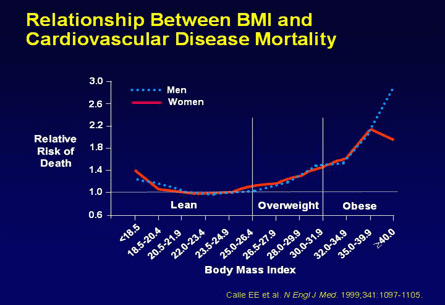
But here's the real question.. what's with the sharp drop off in the women's line above 35bmi?
-
Thanks for pointing that out.. you're right, the line I was looking at was 18.5 for women. Oops. Guess I just was looking at the 20.4. I did the same mistake for the men. 'Parently I need more 'lernin how two reed graffs. Doh!
-
I've had no issues getting my protein in since week 2 postop without protein shakes. During the healing phase it was all about milk, protein kefir (40g in 16oz), yogurt, cottage cheese and homemade broth. After I was on solids: beans, tuna, eggs, and nuts. Every meal features protein containing food. I didn't consume food that didn't have protein until I could eat 3-4oz solid meat at a sitting. Now I can have a couple meals with low protein count (still eating 6 times a day). That's how i get in fruit and veggies.
-
How severe is your diabetes, and do you have a history of GERD? I really think you should put DS out of your mind. The DS requires huge amounts of protein and vitamins that could potentially cause problems with your compromised kidneys. The idea is you won't absorb all of it, but the management would be a nightmare. At your weight, even maintaining 50% excess weight loss will get you into a much healthier range. If you have a history of GERD, go with bypass. If you don't, then if your diabetes is mild (controlled on 1 oral med), or very severe (you've had it a long time or need lots of insulin).. go with the sleeve. If your diabetes is moderate, go with bypass.
-
Very nice. And I agree with almost all of it... but the healthiest BMIs are actually more like 22-26.5 for men and 20.5 to 25 for women.