itstheamarie
Gastric Sleeve Patients
-
Joined
-
Last visited
Everything posted by itstheamarie
-
Please keep me posted on how things are working for you! You're already wildly successful! I know they always say to ease up the cals slowly. Most people gain some when they start upping but will begin to lose again once the metabolism levels out. This whole thing has SO many theories, but I guess we just have to do what works for us. One thing- I had my body fat measured at the gym the other day and realized that at my BF%, It's not likely that I will be able to get down to my original goal without losing a good bit of muscle, so I went with the one this spreadsheet gave me for my desired BF% https://docs.google.com/spreadsheet/ccc?key=0Amt7QBR9-c6MdGVTbGswLUUzUHNVVUlNSW9wZWloeUE
-
That's great! I recently increased my calories while maintaining my workouts and started Losing again. I hope it continues, because I feel so much better working out. I can't live on 600 cal and watch my muscle waste away with the fat. I'm starting to see that leaning how to make better choices that I can stick with for life is MUCH more valuable that losing all my weight super fast along with my muscle. Not saying I don't wish it weren't going faster, but at least it's moving! You are doing AWESOME!! I've been reading a lot about BMR and TDEE. I plan to go that route when I get closer to goal. Eatmore2weighless.com
-
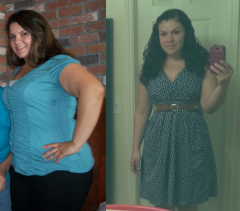
itstheamarie, a weight loss surgery photo album by itstheamarie on BariatricPal. 3 photos in Before and After Gastric Sleeve Photos.
-
There are several factors such as age, weight, height, bodyfat % that play into these numbers. Activity is factored in to TDEE. This is the number of calories you should eat to maintain at a particular weight/activity level. Note that eating at huge deficits alter these values over time, but it is a principle that many people use to maintain a "healthy lifestyle" long term. A lot of people have to do a metabolic reset, as Susan mentioned, to restore their bodies back to these values. To us, these numbers are HUGE compared to our initial post op diet, so it is different for everyone. The principle is the opposite of what most people on here do. It means eating more (feed your body) and work out in moderation, focusing on lifting & strength rather than eating little and racking up cardio. http://scoobysworkshop.com/calorie-calculator/What is BMR? Your basal metabolic rate, or BMR, is the minimum calorific requirement needed to sustain life in a resting individual. It can be looked at as being the amount of energy (measured in calories) expended by the body to remain in bed all day! What is TDEE? TDEE is the common abbreviation for Total Daily Energy Expenditure which is a metric to calculate the amount of calories your body needs to function in a day. This is quite similar to BMR -- in fact, you need your BMR to calculate your TDEE -- but your TDEE accounts for your average daily activity as well to give a figure truer to your specific situation. Basically, the TDEE calculation relies on categorizing your daily activity into one of the metrics' predetermined groupings.
-
Also, when we count calories in restaurant dishes, remember that they grill/sauté with tons of oil! Don't be afraid to ask for fajitas, eggs, or anything else to be cooked without oil. The calories add up in no time even with small portions.
-
http://www.healthydiningfinder.com/home Plug in your zip code and it suggests restaurants as well as some healthy options with nutritional facts and how to order.
-
5#/week is NOT SLOW! Don't let anyone convince you otherwise! We have the opportunity of a lifetime to make changes that will last for a LIFETIME. What a great time to focus on fixing our relationship with food and ensuring that we never go back! I'm sure it took more than 6 weeks to gain it, so I would be more than happy with the loss! I've lost 24 in 11 weeks, so you're blowing me (and most people) out of the water. Just because those of us who lose at a more moderate pace don't post about it doesn't mean that you're alone! As you can see from my numbers, you are far from slow!
-
LOVE body pump!
-
I am sharing this article as food for thought, especially for the slow losers! (The bottom line is to follow the Dr.'s instructions) Many people have found what works for them, but for those of us who feel like we are doing "everything right" and encounter frustrations, a little reading couldn't hurt: This week, several people have brought a recent case-study to my attention and asked me for comment. In it, a 51 year old female began marathon training along with a (self-reported) low calorie diet and either appears to have gained weight or not lost weight (she also showed a very depressed metabolic rate, nearly 30% below predicted). By raising her calories gradually, her body fat (as measured by BIA) came down and her metabolic rate increased. Now, without more details, it’s hard to really comment on this and the link to the case study is the total amount of information available. But we’ve got an older (either post-menopausal or peri-menopausal) woman, undisclosed anti-depressant medication, self-reported food intake and a method of body fat measurement that is, at best, problematic (read Methods of Body Composition Measurement Part 2 for more details). Odd things happen metabolically around menopause, some medications can cause issues, food reporting is notoriously inaccurate and BIA isn’t ideal to track changes. Then again, the measured metabolic rate change is pretty interesting; something was going on. That said, I’ve mentioned in previous articles that one oddity that I’ve seen (and personally experienced) over the years is one where the combination of very large caloric deficits and very large amounts of activity (especially higher-intensity activity) can cause problems for people either stalling or slowing fat loss. Like my previous article on The LTDFLE, or Long-term Delayed Fat Loss Effect, this is one of those oddities that seems to crop up more often than you’d expect. It’s also one where there’s not a ton of research but I will happily provide a good bit of speculation on what I think may be going on. I’d also note that the combination of big caloric deficits and large amounts of activity clearly isn’t detrimental to everyone. Some folks can get away with it but, for many, it tends to backfire more than anything else. First, Some Background Back in my early 20′s, I remember a very specific client I had. She was a little bit, well, to be honest nuts. She was older, I think she had gone through menopause but I wouldn’t swear to that. In any case, she started working with me, determined to lose weight and immediately jumped into something like 2 hours of cardio per day and cut calories massively. She claimed 600 calories per day and I won’t even try to describe her diet; it was insane (Breakfast was supposedly one-half an egg and to this day I’m not entirely sure how you eat half an egg). Now, I didn’t know much at that point but I had this general idea that too much activity and too few calories was a bad thing. For weeks on end I entreated her to either cut her activity or raise her calories. She adamantly refused; how could that possibly work? I tried to point out that what she was doing wasn’t working either and she could hardly do worse by trying something different but that line of logic went nowhere. In any event, at one point she went on a cruise or a vacation or something. And what do you think she did? Exercised less and ate more like everybody does on vacation. And she came back something like 5 pounds lighter (some of which may very well have been The LTDFLE mind you). “See, see.” I told her, “You ate more and exercised less and good things happened.” And she immediately went back to a massive caloric deficit and over-exercising. But that’s how it goes sometimes. Later in my 20′s, mind you, I’d do the same thing during the now infamous Bodyopus experience (probably the singular experience that taught me what NOT to do during a fat loss diet). Frustrated by stalled fat loss (I had dieted far too long at that point in the first place), I worked even harder, cutting calories further and adding more activity. That coupled with some genuinely awful ‘carb-loads’ took fat loss to a standstill. In addition to those case studies, this is a phenomenon that I’ve seen elsewhere including the support forum, I imagine readers run into it constantly: people (frequently but not always women) who try to combine excessive caloric deficits with massive amounts of activity (often with a lot of that activity being high-intensity activity) and nothing is happening. And if you can get them to reduce activity (or just cut back the intensity to reasonable level) or increase calories, things invariably start to work better. . What’s Going On: Let’s Talk About Cortisol Cortisol is one of those hormones that I imagine everyone reading this has heard about and about which a lot of misinformation exists. Simply cortisol is a stress hormone, released by the body in response to nearly all kinds of stress. In the fitness/bodybuilding world, cortisol has gotten an almost exclusively negative reputation (cortisol is ‘bad’ in the way that testosterone and thyroid are ‘good’) although this is simplistically incorrect. Rather, whether cortisol does good things or bad things in the body depends on how it’s released. Simply (and I’d simply, ha ha, refer folks to Robert Sapolsky’s amazing book Why Zebras Don’t Get Ulcers for a detailed look at this; I also talk about cortisol in The Stubborn Fat Solution), acute pulses of cortisol tend to do good things and be adaptive and chronic elevations in cortisol tend to be bad and be maladaptive. For example, the morning cortisol pulse helps to promote fat mobilization. In contrast, a chronic elevation of cortisol (especially in the face of high insulin levels) tend to promote visceral fat accumulation. As a non-fitness related topic, acute pulses of cortisol tend to be good for memory (why we often remember stressful situations in such detail) while chronic elevations (as often seen in depression) make memory go down the toilet. And there are endless other examples of where acute cortisol pulses are good and chronic elevations are bad; again see Sapolsky’s book for details. In any case, dieting in general is a stress. And of course training is a stress. And the more extreme you do of each, the more of a stress occurs. And I suspect that a lot of what is going on when folks try to combine excessive caloric deficits with massive amounts of activity is that cortisol just goes through the roof (there’s another issue I’ll come back to at the end that relates to this). Simply, you get these massive chronic elevations in cortisol levels. Tangentially, this is also one reason I suspect that various types of cyclical dieting help with some of this issue. For at least brief periods, when calories are raised to maintenance or above, you break the diet/training induced elevations in cortisol. This of course assumes that the person isn’t mentally stressed to the nines by raising calories like that but I’m getting ahead of myself. . So Why is This Bad? As noted above, chronic elevations in cortisol can cause a lot of bad things to happen. One of them is simply Water retention and I’ve mentioned in previous articles that water retention can mask fat loss, sometimes for extremely extended periods. I talked about this in some detail in The LTDFLE and suspect that some of the ‘fat loss’ is actually just water loss when calories are raised and cortisol mediated water retention dissipates. Reducing total training (volume, frequency, intensity or some combination) does the same thing. But that’s probably not all of what’s going on. Another effect of chronically elevated cortisol levels is leptin resistance in the brain. I’m not going to talk about leptin endlessly here again, you can read the Bodyweight Regulation Series for more information. When the normal leptin signal to the brain is blocked, a lot of things can go wrong metabolically and I suspect that this is part of the problem. In this vein, although not necessarily related to cortisol per se, at least one study found that the addition of 6 hours per week of aerobic activity to a very low calorie diet (in this case a Protein sparing modified fast) caused a larger decrement in metabolic rate than the diet alone. The body appears to monitor caloric availability (simplistically caloric intake minus output) and if it gets too low, bad things can happen. This is why I so strongly suggested AGAINST the inclusion of much cardio in The Rapid Fat Loss Handbook; it causes more harm than good. Invariably, the biggest source of failure on that plan is when people ignore my advice and try to do a bunch of cardio. And fat loss stops. In any case, there are several different plausible mechanisms by which the combination of excessive caloric deficits an large amounts of activity can cause problems. Whether it’s simply cortisol related water retention, a drop in metabolic rate due to leptin resistance or something else, something is going on. From a more practical standpoint, for a lot of people, the combination simply doesn’t work. Mind you, some seem to get away with it but not all. . An Additional Variable There is another variable that I have noticed over the years in looking at this issue. As odd as it sounds, it has to do with personality. In discussing this, for example, I’ve often noted that the people who seem to have the biggest issues with the whole lots of cardio/big caloric deficit tend to be a little bit ‘tightly wound’ (to put it politely). A bit less politely they are stress cases. You can almost ‘hear’ the stress in their typing. Every post has lots of exclamation points and there is this undercurrent of “I MUST LOSE FAT NOW!!!!!!” in their posts. When fat loss stalls for a day, they freak out and want to cut calories or go add another hour of cardio. You can almost ‘see’ the tension in them as they sit hammering at the keyboard looking for solutions. And this is an issue because these types of folks already over-secrete cortisol. As a true oddity, there is the issue of amenorrhea (loss of menstrual cycle). Typically it’s been thought to be related to body fat levels or caloric intake and this is a general cause. But there is often a type of amenorrhea seen in women without any of the normal predisposing factors. In this case, it’s all due to mental stress. Basically, there is a subset of folks who are already high-level stress cases. They tend to be drawn to harder is better in the first place, tend to be resistant to change (like my client from my early 20′s) and their already high level of cortisol production is simply amplified by the combination of too much activity and too few calories. And suggestions to raise calories and/or reduce activity are invariably met by resistance (again, like my client from ages ago). What they really need is to just chill the hell out. But invariably the approach that they are intuitively drawn to is the wrong one for them: moderate deficits and moderate activity always work better in those folks. It’s getting them to do it that’s the hard part. Tangentially, I suspect that the classic hardgainer is of a typical type but that’s another topic for another day. . Summing Up So that’s that, a look at one of the oddities of fat loss, the situation where the combination of excessive caloric deficits and excessive amounts of activity seem to hurt rather than help fat loss, along with some gross speculation (and just enough research to make it sound like I know what I’m talking about) on what may be going on. In a practical sense, of course, most of the background isn’t that relevant. The simple facts for the majority of folks is this: you can either cut calories hard OR do large amounts of activity. But you can’t do both. Well you can do both, you just probably shouldn’t under most circumstances. Share and Enjoy: Where am I: Blog > Fat loss > Physiology of Fat Loss > Why Big Caloric Deficits and Lots of Activity Can Hurt Fat Loss http://www.bodyrecomposition.com/fat-loss/why-big-caloric-deficits-and-lots-of-activity-can-hurt-fat-loss.html For those of us stressing over numbers but are feeling & looking better & healthier- Should we really chill the hell out?
-
I got mine the day after surgery (2/8) and haven't seen her since...... NO CLUE where's she's at! I don't miss it, but I can't help but think that it must be related to the drastic slow down of my weight loss since her first missed appearance. who knows...I agree with most of the others who say it depends on if the person has realistic expectations. Although it comes easily for some, most vets will tell you it is the very hard to maintain, because lifetime maintenance is based more on the behavioral changes that occurred during the losing phase. Even though the sleeve is a TOOL, there is a chance that it will not actually work FOR you. It will work WITH you. After a few weeks out, we could all eat around the sleeve by consuming nothing but candy and milkshakes. It's all about compliance and how your body handles the changes- mental and physical. :-) But there are always exceptions to both sides of the story!Ya! I went to my first Stars game last night- so much fun! Stumbled upon some cinnamon glazed pecans that ended up giving me a head/tummyache. no buenoI'm about 9 weeks post op, and I'm facing new challenges now that I am released to a regular diet. Being in on the road frequently with business lunches, dinners, buffets plus social situations with bday cake and such is presenting a challenge. 1. I find eating slowly very difficult when I am talking and around others who are eating fast. Plus the "last bite syndrome" when I know I should stop. It's easier to eat the correct amount when I prepare and measure the serving at home. At restaurants, I still focus on protein, but I end up spitting up most of the time, even when I think I did OK. 2. At bday parties and sporting events, my brain gets all fuzzy around sweets. I fixate on them and even when I KNOW better, I KNOW they have no nutritional value, but I just want a taste. I rarely give in for a taste, but it gives me anxiety. 3. I am more obsessed with food now that I ever was. It's nice to focus on making healthy choices rather than eating everything I used to want, but it is constantly on my mind.It's been over 2 months since I've had a cycle! I'm starting to get scared. It's just a reflection of how screwed up my hormones are. I wonder if it's related to my stall... *Sigh*I'm in! Even though I haven't started drinking yet lol. Is there anything in Dallas that doesn't revolve around eating/drinking?!Congrats! It sounds awesome to be in control. Unfortunately, I only lost hunger for a couple weeks and am now more obsessed with food than I ever was. It's in a different way- all about healthy choices and such, but I don't have that freedom from the cravings and head hunger.Me! AddisonLooks like your loss is going well! If it ain't broke, don't fix it :-) My doc's office advised that number of protein= number of carbs, but since I've been stalled for the past 3 weeks, I'm dropping carbs to see if being in ketosis will help move things along. Good luck and please keep us updated!I bought mine at Walmart near the diabetic supplies.I remember the nurses after surgery complimenting me on my desire to get up and walk constantly. I was confused, because that's what we were told to do! They said that more often than not, bariatric patients wake up expecting to be skinny and have no desire to follow the guidelines. I was shocked to hear that, considering the risk, but some of the posts on here really prove it's true! The good thing is that they are on here trying to learn. The bad thing is that some give BAD advice to each other, and it's hard to tell who you should listen to until you've been around a while.Well, I was following my doc's g carbs= g protein recommendation, but it's not coming off how it should, based on my deficit. I started C25K 3 weeks ago and the scale hasn't really moved since then, so I guess I'll give in and try lowering carbs more. Thanks! And regarding the original topic, the Bariatric Advantage chews are great! They also make a 500 mg version now so you only need 2-3 per day, depending on your doc's recommendations.Ah, OK! I didn't realize you were doing it Atkins style. I recall that diet very well. Did you deduct fiber also?I have found that diet Swiss miss hot chocolate will take care of my sweet tooth for 25 cal, 2g protein, 2 g sugar.