Fiddleman
Gastric Sleeve Patients
-
Joined
-
Last visited
Everything posted by Fiddleman
-
I have seen this sort of program with large corporations to help overweight people get healthy (not just WLS folks). For example, Microsoft had a program like this through their health plan that was provided for employee or spouse, if they met the pre qualifications (my sister in law did the program). The program is catered for each individual and includes dietician, psychologist and gym trainer with scheduled appointments every week for 1 year. I am not sure of the cost, but imagine it can be quite expensive (e.g. 1000s of dollars) if an individual had to self pay it. Unfortunately, in the end, my sister in law did not succeed with it even though the plan was customized specifically to her as an individual. Regardless, I think it is a great idea if an individual can commit to it completely.
-
I got a nifty polar hr watch and strap for my b-day and am having a blast with it to improve my run training. It is a high end model and I literally spent a few weeks researching the different hr watches on Amazon before going with it. It does not have gps nor does it count steps or monitor sleep patterns, but that is fine by me as I primarily wanted a hr monitor with "Swiss accuracy." Battery life is supposed to be 5 years. This one trumps my cheap 20 dollar polar watch I used previously. If you have experience with both running and use of a hr monitor for training running patterns, then I have some questions for you. Sorry- this post is going to exclude most folks. If you have the experience and knowledge, feel free to critique in any way. My goal is to improve my running vo2 efficiency through hr training. I just completed a run today of 30 minutes using the watch for the first time. I wanted to see what kind of feedback the watch would give me for a run where I challenged myself. Start hr: 65 (not quite resting) 5 minute warmup up to 6.0 mph: 125 After 5 minute dynamic stretch, hr still around 125 At 5 minutes, speed at 7.0: 135 At 10 minutes, speed at 8.0: 145 Every minute, alternate between 8.0 (149) and 10(155) Finish at 30 minutes: 155 Cool down 6.0 jog for 5 minutes: 135 Walk at 3.5-2.7 for 3 minutes: 105 Total distance is about 4 miles over 30 minutes. Felt fine afterwards and immediately did another 30 minutes of elliptical with hr at 145-150. Here is some HR info a web site calculated for me given sex=male, age=38, resting hr=55 and max hr=186. Resting Heart Rate: 55 Maximum Heart Rate: 186 Heart Rate Reserve(HRR): 131 Fat Burning: From 121 to 134 beats per minute Aerobic: From 134 to 147 beats per minute Steady State: From 147 to 160 beats per minute Anaerobic: From 160 to 173 beats per minute Maximal: From 173 to 186 beats per minute Questions: 1. According to the chart, my sprinting at 155 hr is in steady state range. Is this where it should be or should I go anaerobic? I feel somewhat pushed at 155, but not winded. I could definitely turn up intensity if I should be doing it. 2. I would like my short 1 minute rest intervals after 1 minute sprints to drop lower then 149. How can I get it lower, such as 145 or even 140. I do not feel hr at 149 is giving me enough rest before next sprint. 3. What do you think of my hr at other running speeds (e.g. 135 bpm at 7mph) is that good, ok, bad? I just do not know. 4. If target hr for cardio is about 140 for my age and sex, is this what I should be running at on average (given no sprinting)?According to my watch and running session today, hr=140 is about 7.2-7.5 mph for me. I guess I am looking for some analysis on how to improve vo2 efficiency in the HIIT segments of a running session and what I should be targeting when in various states of running.
-
Bugs me to say this, mark, but I agree with your statement. These instructors do have rudimentary fitness information, but it is so basic, it does not prevent injury in a lot of people, including myself. Maybe things will change. I am learning far more about body form and proper balancing from other sources then I did from the instructors at my cross fit. May not be true In a general sense, but the bar is kind of low to become a certified cross fit instructor. Be careful. If you think you are injured or have a chance of getting injured, sit out the WOD or power lift. It is not worth it.
-
sure Whey - ON gold standard whey Casein - ON gold standard casein Matrix - ON Hydrobuilder I like chocolate in all my protein powders and have gravitated towards using ON (optimal nutrition) because taste is good and results are above average. I have tried a lot of different powders. Everyone has their own favorite powders. This is not to said I am only about powder as I like chicken multiple times a day, but powder makes it easier to hit the daily numbers.
-
Pdxman's information aligns closest to what I have been told, have read about and share with others. More concretely, for active people, Men: 25-30 g for most meals. 40 g is optimal following a hard workout. Women: 15-20g for most meals. 30 g is optimal following a hard workout. High quality casein Protein (slow burning) at night before bed provides aminos in the blood stream all night long. This really helps with fat burning and protein synthesis. High quality whey (fast burning) is best when waking and after a workout. A matrix protein works best for other meals.
-
One strategy that has worked for me is what I have come to term " the boiling frog" strategy. Named this way because intensity slowly raises to a boiling point without the runner being aware they are being boiled. The body ramps up to the intensity as you increment the intensity even more. Once the body is "warmed up" to the intensity, you iterate on the HIIT where both top and bottom parts of HIIT are at a super high intensity and high intensity before returning to a moderate intensity for active recovery. I am sure it is not original because in this modern day it is hard to have a truly original idea. It is based on bringing up the running intensity a little bit at a time (challenging yourself) and then doing a segment of HIIT at high and super high intensity (but not dropping to low intensity as you would with standard HIIT) followed by an active recovery. Do this two or 3 times during a running session. I did this today and ran for an hour, burning about 1200 calories total (a lot at my 5'11" 180#) and running 8.2 miles. Not only did my 5 k and 10 k times come in at fast race times, but after the high intensity segments, the active recovery felt like easy jog). This approach will get you running at race competition speeds in no time. It is best done on a treadmill with a hr watch . I use a polar watch and hr strap around chest. do not grab handle bar sensors when sprinting. this approach I think would help prepare someone for being the best in a race. Not sure because I do not race, but it would seem to be a good strategy. Here is breakdown to demonstrate (scale mph depending on your level- this is my level) 5 minute jog (6.0 mph or whatever is jog for you) warmup 5-10 minute dynamic warmup stretching Minute MPH Notes 1. 6.0. Starting speed, increase .1-.2 every minute until 8.0 is reached. Hr below and moving in fat burn zone. 5. 7.0. 10. 8.0. Every minute, alternate between 8.0 and 10.5 until 20 min. Hr in or above cardio zone. 15. 20. 7.5. Drop into active recovery for 2 min. Hr in fat burn zone. 25. 8.0. Every minute, alternate between 8.0 and 10.5 until 30 min. Hr climbs up in and above cardio zone. 30. 6.5. Drop into active recovery for 2 min (lower then first time), increase .1-.2 every minute until 8.0 reached. hr should be fat burn zone or lower. 35. 7.0. 40. 8.0. Every minute, alternate between 8.0 and 10.5 until 50 min. 10 k at 43 min. Hr is moving in cardio zone. 45 50. 7.0. Drop into active recovery for 2 min, increase .1-.2 until 60 min. Hr is in fat burn zone. 55 60. 8.0. Hr at or above cardio zone. 5 min cool down ( gradually get your hr down into low 120s and down below 100) 5-10 stretching (static and isometric)
-
Then have your cup of coffee. Really. Some doctors say no coffee and some say no restriction. No idea why there is a difference other than superstition. Coffee is a daily staple! The caffeine from coffee also is a mild thermogenic and will metabolize fatty acids in the blood stream -a fat burner.. There are many benefits to coffee. Just don't overdo it because dehydration is no fun in more ways than one.
-
My opinion is that you will not be able to eat enough calories or carbs to make it through a met con like filthy 50 or murph at 6 weeks post op. Even the shorter AMRAP met cons will be a challenge because you will probably bonk way to early and it could be, in fact, dangerous in terms of dehydration, electrolyte imbalance, etc. . Crossfit is very demanding as you are aware and requires a lot of energy from good food. I started cross fit at month 7, but that is mostly because I didn't find out about it until month 5 or 6. I then spent the next 6 months with a PT doing cross fit 2x a week and at home workouts on 3-4 more days. It was not until about 14 months post op that I got to where I was doing met cons 4-5 days a week and was quite good at it (top 1 or 2). I was eating 7-8 x a day paleo and a lot of Protein. Paleo AMRAP bars were my favorite after cross fit at 300 calories of mostly oats and honey, but man, they were/are expensive. The company that makes them has a hold on the market and will not let anyone sell them for less than $3 a bar. I had no issue losing and, in fact, needed to muscle up more. I was underweight at 168 (5'11") and that was limiting my lifting ability. I was really good at gymnastic type exercises like push-ups, pull-ups, squats, running, jumping, etc. not so good at lifting overhead with thrusters, cleans and jerks. I still eat this was today at post op 23 months, but stopped cross fit 3 months ago because it took a toll on my shoulders. I plan to return in a few months to the box, now a little smarter about the body mechanics in terms of lifting overhead. When I go back, I will be more careful about not pushing through injury and preventing injury altogether now that my body and I have a very good understanding of physical mechanics. All in all, you have to be able to eat to have the energy to get through cross fit. For this reason, I think you should wait until you are able to eat enough, drink enough and move in athletic ways without fear of injury.
-
I have read over and over about the need to eat carbohydrates with the protein or your body cannot process protein well. It will not matter how much protein you eat (e.g. >300 g). Without a 2:1 or 4:1 ratio of carbs to protein, it will be wasteful. I like to eat about 60g of good carb with 30 g whey protein for first meal and 80-100 g of fast burning carb with 25 g protein post workout (around 5 pm). Minimal carbs for the rest of the day. 50 % protein, 30% carb and 20% fat has worked out really well for me and is very manageable spread out over 1800 calories. I eat a total of about 255 G protein a day on strength days, a little less on cardio days. It has been working well in terms of building up muscle. And of course you have to give your muscles a reason to eat, so push the iron hard in your program. For the last 3 months, I have been doing p90x and that is a superb well rounded program to body build, as long as you bring the challenge. I am now going into more of a functional body weight program for a couple months, to give myself a change from isolation based exercises of p90x. It is called EFX by Mark Lauren -superb! Also check out "you are your own gym" by the same guy. I never get tired of those workouts. They are short (20-25 min), but really effective for building a strong athletic body. Functional over isolation may be what you are looking for to build a balanced muscular body for 3 days of strength training a week. As for cardio, I am doing fat zone cardio on my 3 strength days and a combination of high intensity / medium intensity on my 3 cardio days. One rest day.
-
I agree with the sprinting suggestions. This is how I have self taught myself to run fast. One approach that has helped me when I first started running following WLS is "Chi Running." There is lot of free information on this running philosophy. I find that only when the body is in a state of relaxation, there is a strong stable core and there is elegance around every movement, only then can true speed be achieved in an effortless manner. My comfortable running speed is currently 8.5 mph where my max sprint speed is currently 12.3 mph. It usually takes me about 20 minutes to reach my comfortable running speed and I can maintain that for up to 10 k (and then run out of gas). I find if I run too fast too soon, then I cannot sustain the comfortable running speed to complete a 10 k. Is sprinting still the approach to achieve a faster ramp up to comfortable running speed or should something else be considered.
-
Yup, those walking planks are indeed fun. Another one I learned just a few days ago is called the body rock. Get in plank position and without losing the straight line, rock as far forward as you can on your toes and then as far back as you can on your toes. Do this for one minute. Try and do these 5 x. Another good one I also picked up at the same time is what I think is called a scissor kick plank. Start in a plank position and hold for 1 min. After 1 min, lift your right foot slightly off the ground and scissor it out as far as you can go to the right, keeping shoulders, back, butt and heel in a straight line. Strong core. Now scissor it back to middle. That is one rep. Do the right side for 5 x without loosing the straight line and not dropping your foot. Without stopping, now do the left foot for 5 reps. Do 5 sets of this sequence (plank hold 1 min, scissor right 5x, scissor left 5x) without stopping.
-
Yeah - he is always herding them, especially when they get into tiffs with each other. He gets between them and breaks it up. He is pretty good at it.
-
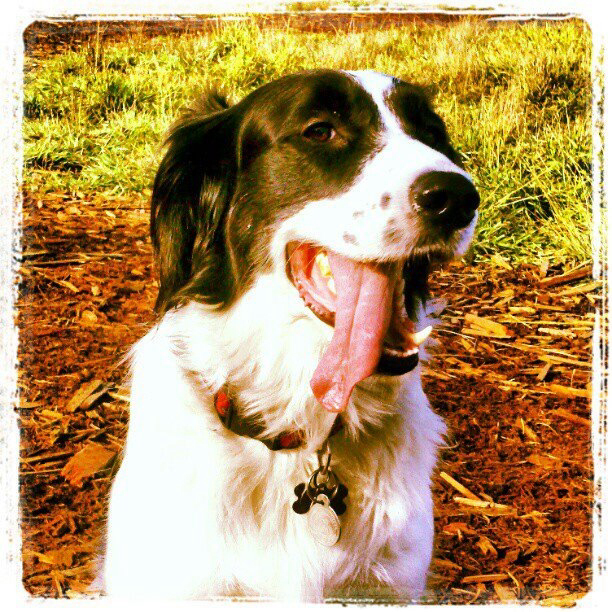
My wife and I adopted / rescued Remington ("Remi" or "Rem" is what we always call him) a few years ago. He was on a kill list. Can you believe that? He is a great addition to our family. He is 1/2 English springer and 1/2 border collie. We also have 3 cats, but no assessable pictures of them for now.

-
Honestly, my approach is very low tech:1-2 32 oz containers of water and 8-16 oz of drip coffee. Works every day in the morning right after I get up. I also try and eat high fiber when I can, but that is unpredictable for *when* it will actually work. Sometimes my approach doesn't work if I just took a plane ride or otherwise disrupt my normal schedule of things. If I get in a bind, I use MOM.
-
Currently, I have coffee (or some other form of caffeine) every day. It helps with focus and energy for both work and working out. Additionally, it helps with daily bm. In our program we could have coffee up until day before surgery and then after surgery, when we were ready. In reality, I did not take on coffee until month 2 and started small with ounce size expresso shots. I worked my way through tall, grande and venti sizes over six months. I enjoy the benefits of caffeine.
-
I am transitioning into a new workout plan starting June 1st and am thinking about how to best organize a cardio day for maximum fat burning. It has been common knowledge for people to do a cardio workout first in the morning, in a fasted state, such that stored glycogen will be depleted and there is no in transit carbs or fat to use for energy. There have been many published studies on the approach. The principle is that muscles will use stored fat instead of stored glycogen for energy. In theory I believe this to be true, but pragmatically do not have the time to exercise in the morning because of earlier shift work. Would the following approach produce similar results (any time of the day, but 2-3 hours after last meal): 20-30 minutes of high intensity resistance cardio (e.g body weight exercises in HIIT or Tabata protocol) followed by 20-40 minutes of steady state medium intensity cardio (HR is in fat burn zone). The principle behind this approach is that the glycogen stores are depleted in the 1st high intensity segment. The resistance cardio should be done close to failure during each HIIT or Tabata interval within this segment. The second steady state cardio segment purely burns fat because stored glycogen has been depleted during the first segment and there will not be any in transit food as it will have been 2-3 hours since last meal. Assume a 3-2-2 split where there are 3 lifting days, 2 cardio days and 2 rest days in a week. Monday: lift / med intensity cardio Tuesday: high intensity resistance cardio / med intensity cardio Wednesday: lift / med intensity cardio Thursday : yoga /stretching Friday: lift / med intensity cardio Saturday: high intensity resistance cardio / med intensity cardio Sunday: rest A lifting day will have 20-30 min cardio following isolated lifting segment This is a theory of mine I have been playing around with and am wondering what others think.
-
How about a gift for yourself that is particularly meaningful? For some, it might be a car they really like. For others, a dream vacation. Perhaps for you it is something horse related, like a new fancy saddle. The point is that the gift celebrates your hard work of a lifetime achievement. I say you are worth it.
-
I cannot agree with the others above more : exercise is a great anti depressant. From experience, I have taken my fair share of mood leveling antidepressants in the past (when obese), but nothing, and I mean NOTHING, feels better than finishing an exercise session. Endorphins are flowing, giving you a positive burst of energy for at least the rest of the day. And it gives you motivation to take another step in the right direction; make another change. Success is one small change at a time. You have done well so far and, yes, I do remember you from the beginning with all your knowledgable posts. Keep up your successes!
-
One banana a day is actually good for you as it will help regulate your digestion and it contains pectin, a dietary fiber which is metabolized into fat burning enzymes by good bacteria in the stomach and intestines. Do not have more than one a day because of the high Glycemic index and you might time it for first meal of the day or post workout meal. These two times are when the body can best process carbs optimally. Carbs are required for protein synthesis to occur so you must eat them. They also regulate so many processes in the body, many of them neurological.
-
Ah yes, spectacle lake. It is on my favorite part of PCT between Stevens and Snoqualmie Pass. I know that area well and there are many other good hikes in the Vicinity. From 90, there are actually 2 routes out to Spectacle Lake. The first is along the PCT and can be done in a single day of all day hiking (dawn to dusk) or two if you stop at gravel lake for the night. I prefer to do it in two because you can relax a little more during the actual hike. Be warned that there is fairly little water between Gravel Lake and Spectacle lake so pack a lot of water. The sun really beats down on you along this stretch as you hike along high alpine rocky territory. Very little growth if any, but pretty exciting nonetheless. There is also a neat cat walk before gravel lake that has sheer rock drop offs of 2000+ feet. Don't look down! The second route is via Pete's Lake. It is a much tamer hike and much of it is spent in the shadows of trees in the valley. Not as much fun though and definitely not as scenic. Spectacle lake is so beautiful. It is one of my favorite memories from hiking as a teenager. It is one of those places you never want to leave.
-
Hiking is one of my favorite outside activities. Love it. I live in the Pacific Northwest (specifically Washington) so have done a lot of different hikes from PCT (Pacific Crest Trail) to Camp muir on Mt Rainier to summit of mount Adams to a million day hikes in the cascades and Olympics. I do have to say hiking on the PCT is my favorite, especially between Stevens pass and Snoqualmie Pass. When you go out, remember to hydrate 2x as much as you think you will need, maybe 3x. And take plenty of protein snacks, even if they happen to be cliff bars. Trust me, your body will burn through the calories and then some. Have fun!
-
Starting to feel myself today. Thanks for the kind thoughts everyone.
-
A supplement that helps with DOMS is called beta-alanine. It reduces muscle inflammation as an anti-oxidant and buffers against high levels of lactic acid after that heavy lifting or HIIT session. It is best to take beta-alanine directly instead of carnosine (an aggregate of beta-alanine and histinine) because carnosine must be broken down into its parts during digestion and loss of beta-alanine will occur. Beta-alanine takes 3-4 weeks to build up to where it is useful to prevent DOMS and also boost athletic performance; specifically anaerobic high Intensity interval training activity. Jump higher, sprint faster, lift heavier and most importantly, avoid DOMS. It is very cheap and can be found at most vitamin stores or online at Amazon. For reference, I order mine from NOW and am still working through the same container I bought last year. One container lasts a very long time. I never get DOMS since using this supplement a year ago, even when doing some very heavy lifting or pushing myself through cross fit bursts of exercise. I find myself able to exercise (functional cardio and lifting or isolation lifting) 6-7 days a week. It it good to cycle beta-alanine, like any supplement, after 3 months or so to prevent tolerance. This is one of the few supplements that actually works well for most people (creatine is another).
-
I played fiddle a lot during my college years (helped pay tuition, books and food). For a short while, I even was part of a Celtic band and we played a few pro venues (read: paid), including show box in Seattle. One of my favorite busking places was on capital hill because people were so giving and colorful. Now that I am "grown up with responsibilities", I have not fiddled so much in the last 10 years because of family, work and other time commitments, but I would love to get the bug again to do it. I used to play all over the Seattle area at this jam session and that jam session, hopping from tavern to bookstore to eatery, usually given Guinness for our tunes. So that is where my user name comes from.
-
Respiratory issues are gone, but really tired all the time and body aches. I just want to sleep all the time. Threw up a couple times yesterday and still can't hold food that well today without getting nausea.